Public Toilets in China: What Travelers Need to Know (2026)
Public toilets are easy to find in many Chinese cities, transport hubs and attractions, but the facilities inside are not standardized. You may encounter a modern seated toilet at a shopping mall, a squat toilet at an older station, or both in the same washroom. Carrying a small tissue pack and hand sanitizer removes most of the uncertainty.
TL;DR
- Look for the signs 厕所 (toilet), 卫生间 (washroom) or 洗手间 (restroom).
- Large malls, airports, newer railway stations and major attractions are the most reliable places to look for a seated toilet, but availability varies.
- Carry tissues, hand sanitizer and a small disposal bag. Do not assume every stall provides paper or every sink has soap.
- Squat toilets remain common. Place your feet on the raised foot pads, face the front of the fixture and keep clothing clear of the floor.
- Use the waste bin when a sign asks you not to flush paper. Plumbing rules differ by building.
- For accessibility needs, identify suitable facilities before leaving a major hub and ask staff for 无障碍卫生间 (accessible toilet).
Why It Matters
A toilet stop can become stressful when you are carrying luggage, traveling with children, managing limited mobility or moving through a busy station on a short connection. The difficulty is rarely that China has no public facilities. It is that toilet type, supplies, accessibility and signage can vary sharply between a new airport and an older neighborhood building.
A simple plan makes the experience routine: recognize three Chinese terms, use map apps and staffed venues, carry basic supplies and leave extra time at transport hubs. This guide focuses on those practical decisions rather than promising a single nationwide standard that does not exist.
Where to Find Public Toilets
| Place | What to expect | Best use |
|---|---|---|
| Airports and newer railway stations | Frequent signs; usually several washrooms and often an accessible facility | Best option before a long transfer |
| Shopping malls and department stores | Generally maintained facilities; toilet type still varies by building and floor | Most comfortable city-center option |
| Museums and major attractions | Public facilities near entrances or visitor-service areas | Plan a stop before entering a large site |
| Metro stations | Not every system or station has identical access; location may be outside fare gates | Ask staff rather than searching every platform |
| Public parks and street facilities | Clearly marked in many cities; supplies and toilet type vary | Useful during long walking days |
| Cafes and restaurants | May be customer-only or shared with a mall/building | Backup, not a guaranteed public facility |
Shanghai’s official visitor Q&A recommends searching WeChat for 上海智慧寻厕, a mini-program that locates nearby public restrooms. Other cities may provide their own map services. You can also search 公共厕所 in Amap or another local map; our China map-app guide explains how to verify the correct entrance and pin.
Recommended Apps and Tools
- Amap Global or another local map: search 公共厕所, 厕所 or 卫生间.
- Translation app: use camera translation for disposal, accessibility and maintenance notices. See our translation-app comparison.
- Pocket tissues: carry your own even when a venue normally supplies paper.
- Hand sanitizer: useful when soap is empty or the sink is outside the stall area.
- Small disposal bags: helpful for used hygiene products or wet clothing; never leave waste on the floor.
Step-by-Step Guide
Step 1: Recognize the signs
The most useful words are:
- 厕所 — toilet;
- 卫生间 — washroom;
- 洗手间 — restroom;
- 男 — men;
- 女 — women;
- 无障碍卫生间 — accessible toilet;
- 母婴室 — mother-and-baby room.
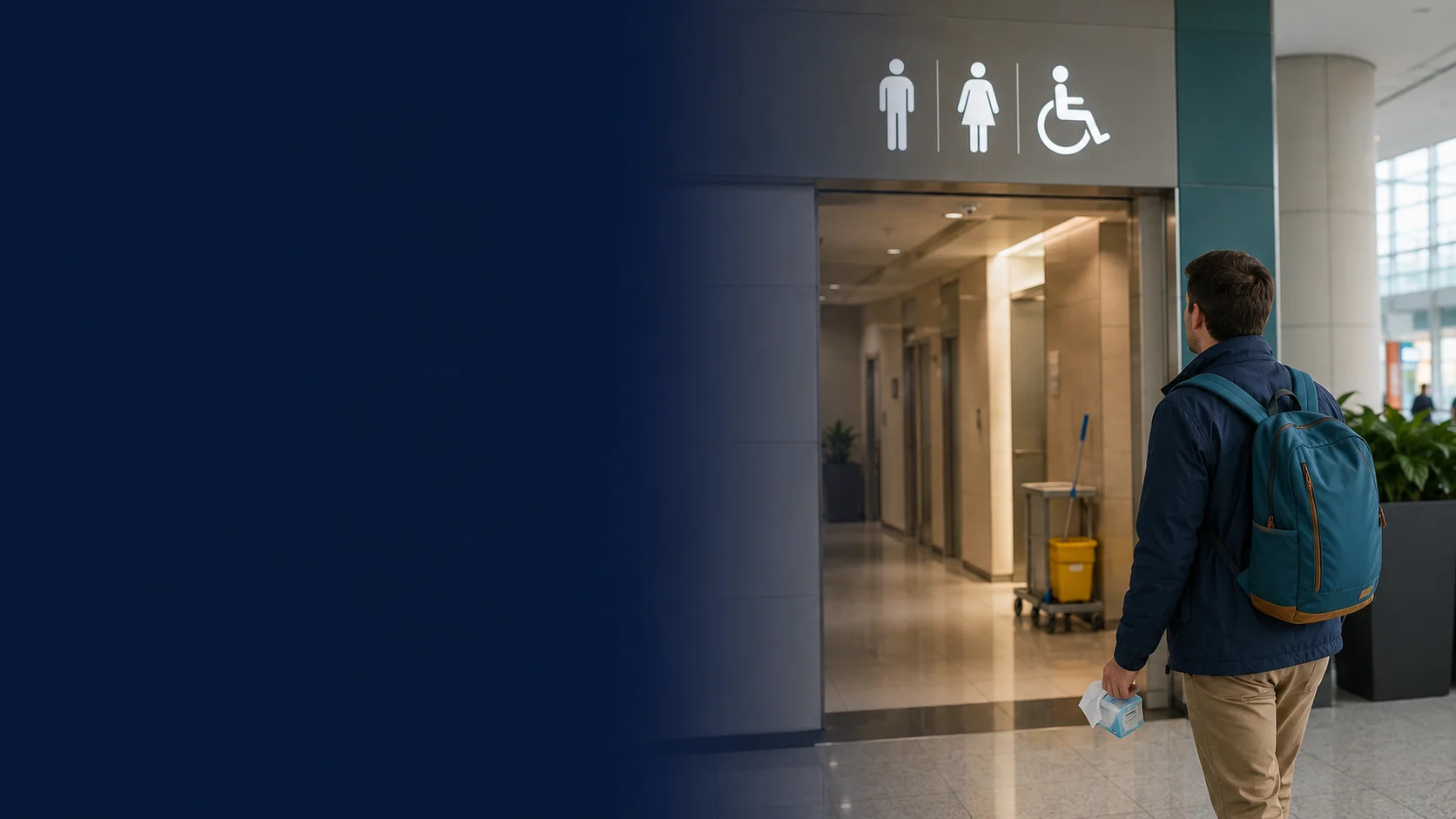
Universal pictograms are common in transport hubs and malls. When you cannot find a sign, show a staff member “请问,卫生间在哪里?”—“Excuse me, where is the washroom?”
Step 2: Check the stall type
Many washrooms contain more than one toilet style. A seated toilet may be marked with a simple toilet-seat pictogram, while a squat toilet may have a squat-position symbol. Check several stall doors before assuming there is no seated option. Do not stand on a seated toilet: the seat is not designed for squatting and can break or cause a fall.
Step 3: Use a squat toilet safely
- Choose a stall with a dry, clear floor where possible.
- Place one foot on each textured foot pad.
- Face the raised hood or front of the fixture.
- Lower clothing enough to keep it away from the bowl and floor.
- Squat with your feet flat and use a handrail if one is provided.
- Flush using the button, pedal, lever or sensor indicated in the stall.
If balance or joint mobility is limited, do not force the position. Ask staff for an accessible or seated toilet and plan stops at major venues.
Step 4: Check how to dispose of paper
Follow the sign in that washroom. Some buildings allow toilet paper to be flushed; others ask users to place it in the bin because of the local plumbing system. A bin does not automatically tell you the rule—it may be intended for hygiene products—so use any posted instruction as the authority. Sanitary products, wipes and diapers should not be flushed.
Step 5: Wash and repack
Sinks may be inside the washroom or in a shared area outside the stalls. Some taps and soap dispensers use sensors. Dryers, paper towels and soap can run out, especially at busy times, which is why a small personal kit is worthwhile.
Step 6: Plan before a long journey
Use a toilet before boarding, but do not assume that is your only chance. Chinese high-speed trains normally include washrooms, with configurations varying by train type. Accessible facilities are often located in specific carriages, so travelers who need them should ask station or train staff. Review our high-speed rail guide and domestic flight guide before travel.
Accessibility, Children and Medical Needs
China’s major cities have been renovating public toilets for safer access. Shanghai reported a program to renovate 1,200 public toilets by the end of 2024, with changes aimed at older adults, people with disabilities and children. Beijing’s accessibility plan requires qualifying public toilets to provide independent or usable barrier-free facilities. These programs are meaningful, but they do not guarantee that every older building or rural stop will meet the same standard.
If access is essential, identify facilities at your hotel, airport, railway station, major mall or museum before beginning the day. Ask for 无障碍卫生间, and confirm whether the room is unlocked and available rather than relying only on a map symbol.
Parents can search for 母婴室 in airports, large stations and malls. A baby-care room and an accessible toilet are not the same facility, although some transport washrooms include changing tables.
Travelers with an urgent gastrointestinal or continence condition should keep supplies, medication and a Chinese-language explanation card easily accessible. This article is general travel information, not medical advice.
Common Mistakes
Waiting until the last possible moment
A map pin may be inside a large park, station or shopping center. Use a facility when you see a convenient one, especially before security lines, boarding or a long attraction route.
Assuming every public toilet is paid
Many public facilities are free, but access conditions vary. A venue may require a ticket, a customer code or entry into the building. Carrying a small amount of cash and working mobile payment is sensible, but do not treat a QR code near a washroom as trustworthy unless it clearly belongs to the venue.
Assuming supplies are guaranteed
A well-maintained facility can still run out of paper or soap during a busy period. Carrying tissues and sanitizer is more useful than trying to predict which venue will have everything.
Flushing wipes or hygiene products
Wet wipes, diapers and sanitary products can block plumbing even when ordinary toilet paper may be flushed. Put them in the designated bin.
Using an accessible toilet as a storage stop
Keep the room available for people who need the space, handrails or changing facilities. Do not leave luggage blocking the entrance.
Trusting an old map listing
A street toilet may be closed for cleaning or renovation. Check another nearby result and use staffed malls, hotels or transport hubs as reliable fallback locations.
Public Toilet Checklist
- Save 厕所, 卫生间 and 无障碍卫生间 on your phone.
- Carry pocket tissues, sanitizer and a disposal bag.
- Check several stalls for a seated option.
- Follow the building’s paper-disposal notice.
- Use staff help for accessible facilities.
- Plan a toilet stop before security, boarding and long walks.
- Keep your phone and small valuables secured in a zipped pocket.
FAQ
Are public toilets common in China?
They are widely available in airports, railway stations, malls, parks, attractions and many urban public spaces. Density and opening hours vary, so use a local map and prioritize staffed venues when time is limited.
Are public toilets in China free?
Many are free, especially municipal facilities and toilets inside transport hubs or malls. Some toilets are available only after entering a ticketed attraction or customer area. Avoid claiming a nationwide rule for every location.
Will I find Western-style seated toilets?
Often, particularly in airports, newer stations, large malls and hotels, but they are not guaranteed in every washroom. Check all stall symbols and ask for a seated or accessible toilet if you cannot use a squat toilet.
Should I carry toilet paper?
Yes. Paper is provided in many modern facilities but can be absent or run out. A pocket tissue pack is one of the simplest items to add to your day bag.
Can toilet paper be flushed in China?
It depends on the building and plumbing. Follow the posted instruction. Never flush wet wipes, diapers or sanitary products.
How do I find an accessible toilet?
Search or ask for 无障碍卫生间. Major airports, newer railway stations, malls and public attractions are the best starting points, but confirm availability with staff.
What should I do if I become ill while traveling?
Return to your hotel or another staffed place and seek medical help when symptoms are severe or persistent. Keep the numbers in our China emergency guide available offline.
References
- Shanghai Municipal Government: locating public restrooms with 上海智慧寻厕
- Shanghai Municipal Government: public-toilet accessibility renovations
- Beijing Municipal Government: barrier-free public-toilet requirements
- China Discovery: current high-speed train washroom configurations
Fact-checked on August 8, 2026. Toilet type, supplies, opening hours, disposal rules and accessibility vary by city, venue and building. Follow local signs and staff instructions.