China Power Plugs, Voltage and Adapters: 2026 Travel Guide
Most phones, laptops and camera chargers work in China with only a plug adapter. Hair dryers, curling tools and other heat-producing appliances are where travelers get into trouble. Mainland China uses 220-volt, 50-hertz electricity, so the small print on the device matters more than the shape of the plug.
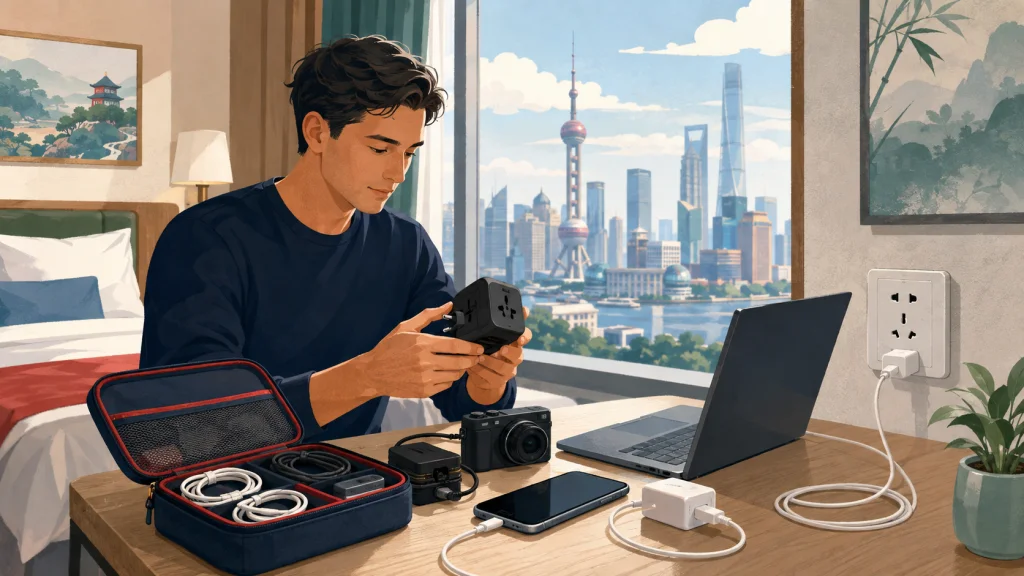
This guide explains what to pack, how to read an input label, when an adapter is enough, when a voltage converter may be required, and how to charge devices safely in hotels, trains and airports.
Quick answer: what adapter do you need for China?
- Voltage: mainland China uses 220V at 50Hz.
- Common socket shapes: two flat parallel pins, two round pins and three angled flat pins are widely encountered. One wall plate may accept more than one style.
- Phones and laptops: most modern chargers marked Input 100–240V, 50/60Hz need only a mechanical plug adapter.
- Single-voltage appliances: a device marked only 110V or 120V is not suitable for a 220V outlet without an appropriate voltage converter.
- Best simple setup: bring one well-made grounded universal adapter plus your normal USB-C chargers.
Hong Kong and Macao use different socket conventions from mainland China. If your itinerary includes either special administrative region, pack an adapter that explicitly covers all destinations.
China voltage and frequency
The nominal supply in mainland China is 220 volts and 50 hertz. A Chinese government technical guide describes domestic computer equipment as operating on 220V/50Hz, while official event guidance for visitors lists a 220–240V, 50Hz range. Normal variations do not change the packing decision: check every appliance for 220V compatibility before connecting it.
The voltage difference is important for visitors from countries such as the United States, Canada and Japan, where many household appliances are designed around roughly 100–120V. Travelers from much of Europe, Australia and other 220–240V markets are more likely to have compatible appliances, although they may still need a plug adapter.
Plug adapter versus voltage converter
These accessories solve different problems:
- A plug adapter changes the physical pin shape. It does not change voltage or frequency.
- A voltage converter or transformer changes electrical voltage. It may be needed for a single-voltage device, but it must also be rated for the appliance’s wattage.
- A USB charger converts wall power into low-voltage USB output. A good multi-port USB-C charger can replace several separate chargers, provided its input label includes 220V.
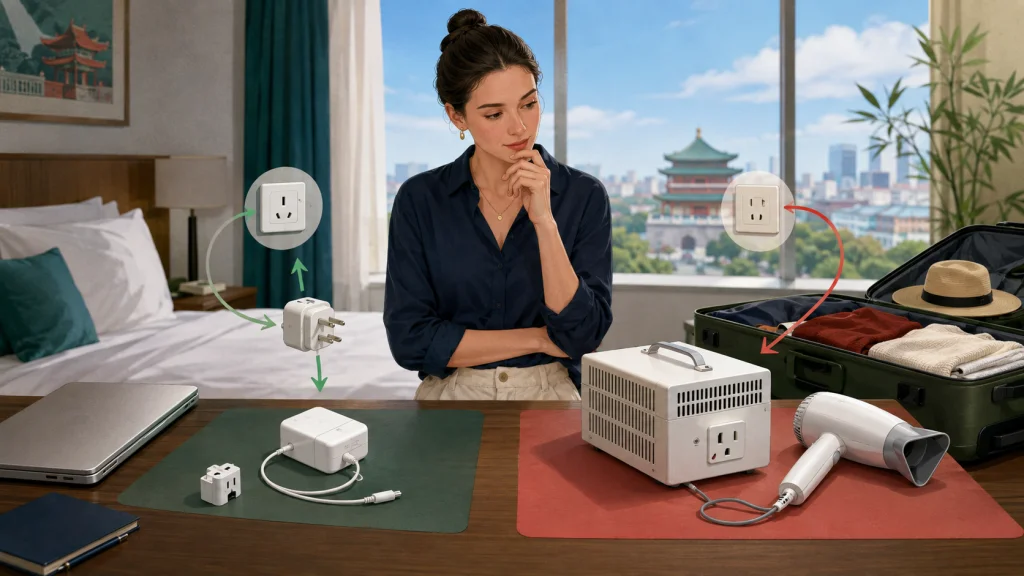
Do not assume that a universal travel adapter converts voltage. Most do not. Labels such as “world adapter” or “international adapter” usually describe compatible pin systems, not electrical conversion.
How to check a charger label
Look on the charger brick, power supply or appliance body for the word Input. The key examples are:
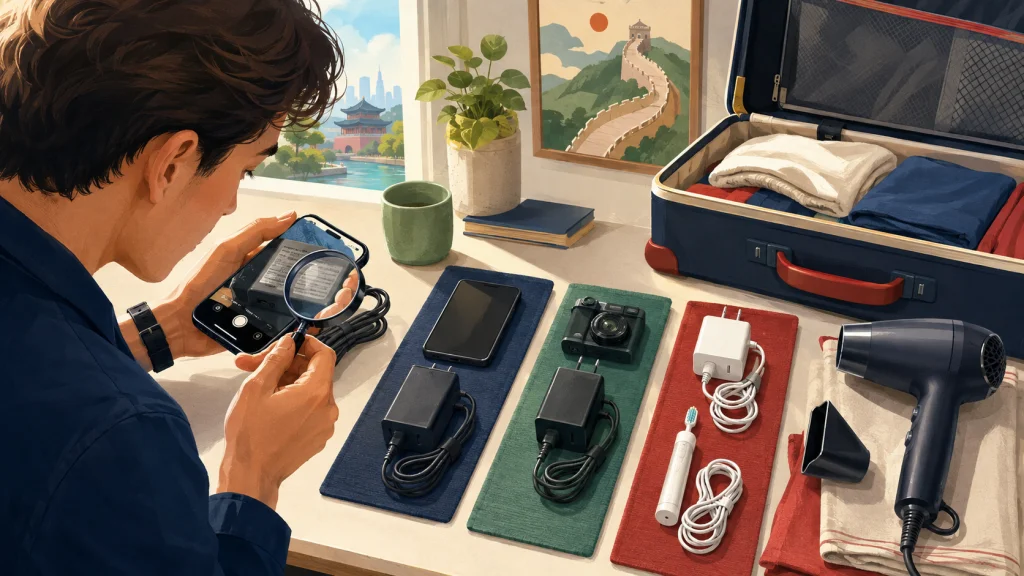
- Input: 100–240V ~ 50/60Hz — dual voltage; normally safe on China’s supply with the correct plug adapter.
- Input: 220–240V ~ 50Hz — compatible with mainland China.
- Input: 110–120V ~ 60Hz only — not directly compatible; leave it at home or use a properly rated converter.
Check the charger, not the device’s battery label. A laptop battery might list low-voltage DC specifications, while the detachable wall charger shows the relevant AC input range.
Which devices usually work without a converter?
Modern smartphone, tablet, laptop, camera and electric-toothbrush chargers are commonly designed for 100–240V, but “commonly” is not a guarantee. Read the label on the exact charger you are packing.
High-wattage heat appliances deserve extra caution. Hair dryers, straighteners, curling irons, travel irons and some electric shavers may be single voltage. A small cheap converter can overheat when used with a powerful heating element. A hotel-provided hair dryer is usually the safer and lighter choice.
What to pack
For travelers carrying multiple high-power electronics or family gadgets, a modular adapter kit like the Ceptics World Travel Adapter Kit (with 6 Attachment Plugs) is an ideal solution. It includes Type I and Type C attachments for mainland China, as well as Type G for Hong Kong, allowing you to connect dual-voltage laptops, cameras, and phone chargers safely across your entire Asian itinerary.
For most travelers, a compact charging kit is enough:
- One grounded, safety-certified universal travel adapter.
- One reputable multi-port USB-C charger marked 100–240V, if several devices use USB charging.
- The original or a certified replacement cable for each device.
- A short extension lead only if it is explicitly rated for 220–240V and the expected current.
- A compliant power bank carried in hand luggage, not checked baggage.
Avoid very loose adapters, cracked housings and devices with exposed metal. Do not create a heavy stack of adapters and chargers hanging from one wall socket. If the adapter feels unusually hot, smells scorched, sparks or repeatedly loses contact, unplug it and stop using it.
Hotel charging: what to expect
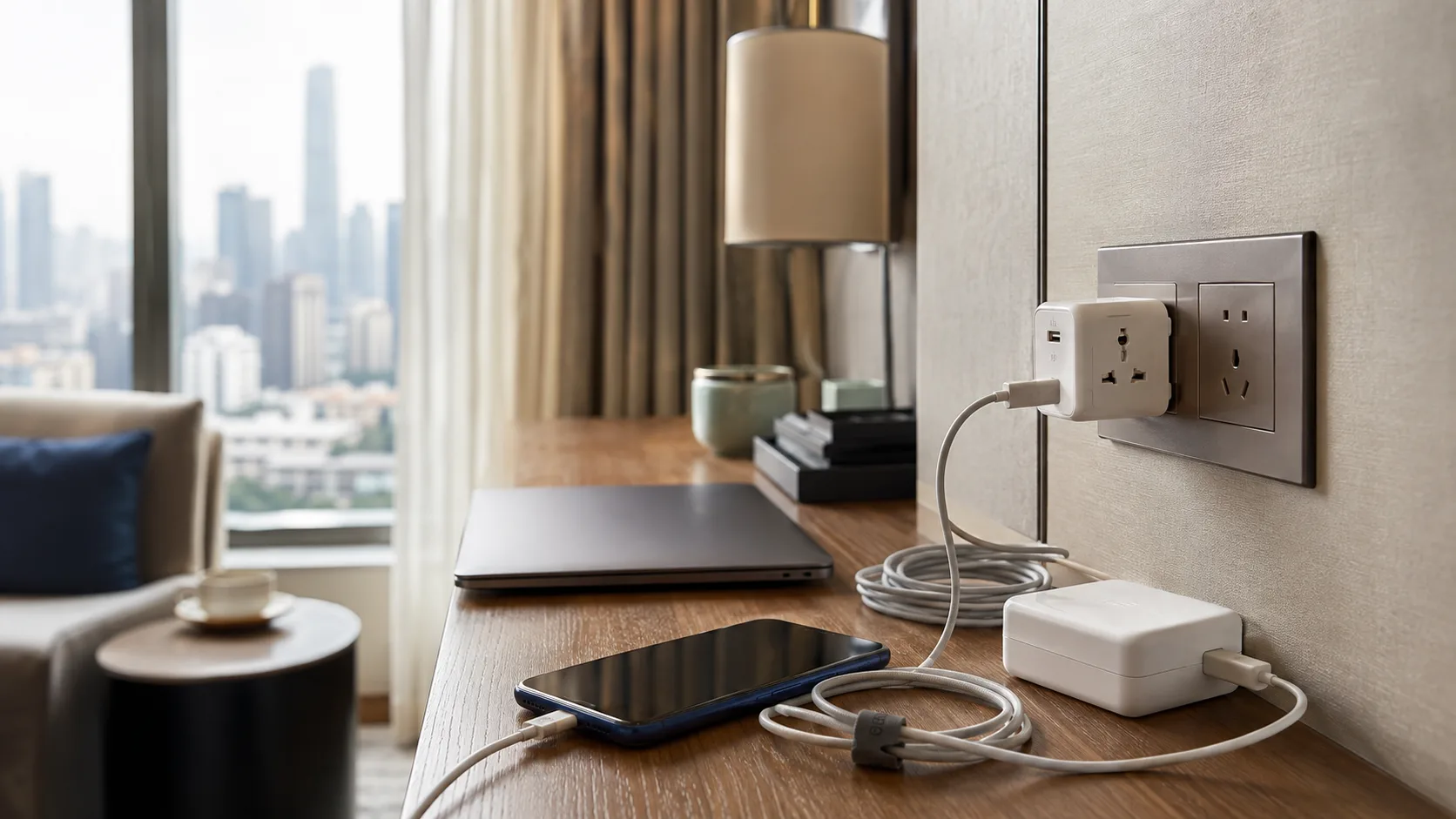
Many modern Chinese hotels provide multi-standard wall outlets, USB-A ports or USB-C ports near the desk and bed. Availability is inconsistent, especially in older properties, guesthouses and budget rooms, so a universal adapter remains useful.
Built-in USB ports can be slow or poorly maintained. Your own reputable charger gives you more predictable charging speed and electrical protection. For data-security peace of mind, use a power-only wall charger rather than connecting a phone to an unknown computer or public data terminal.
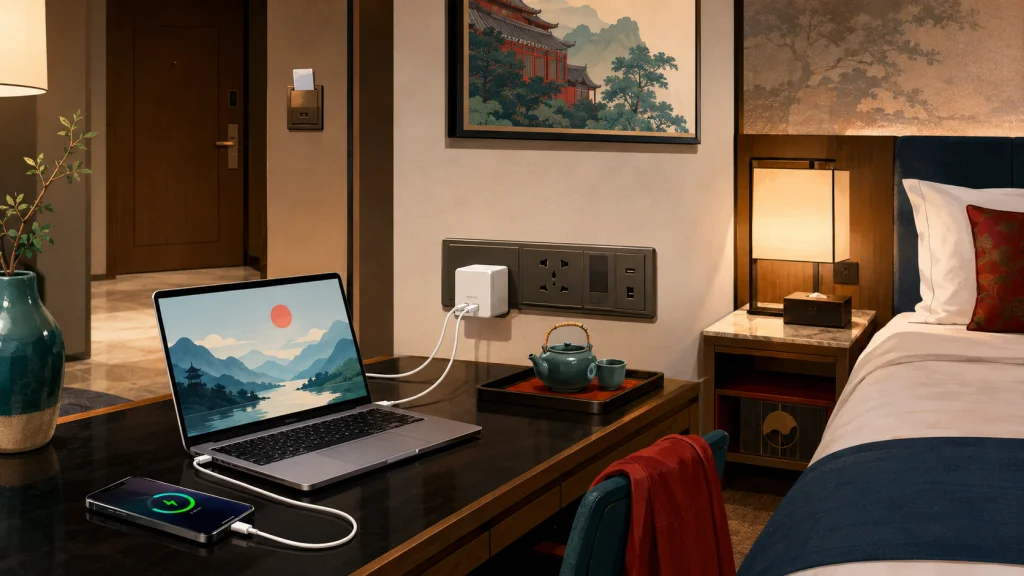
Some rooms require the key card to keep power on. If charging stops when you leave, ask reception whether a designated outlet remains live rather than defeating the room’s energy-control system.
Before reserving accommodation, our China hotel booking guide for foreign visitors explains passport check-in, registration and practical booking checks.
Charging on trains, metro systems and at airports
Power sockets and USB ports vary by train type, carriage and seat. Do not rely on having a working outlet for an entire rail journey. Charge before departure and keep the cable where it will not cross an aisle. Our China high-speed rail guide covers ticketing, stations and boarding.
Airports and major stations increasingly provide charging facilities, but demand can be high. Use equipment only as designed and keep your devices in sight. Metro trips are usually short, so treat station charging as a backup rather than part of the plan.
Power-bank rules for flights in China
When traveling domestically by air in China, civil aviation rules strictly require power banks to be under 100 Wh with clearly marked capacities. We recommend carrying a CAAC-compliant Anker 20,000mAh Portable Charger in your carry-on luggage to stay powered up on long train and flight legs.
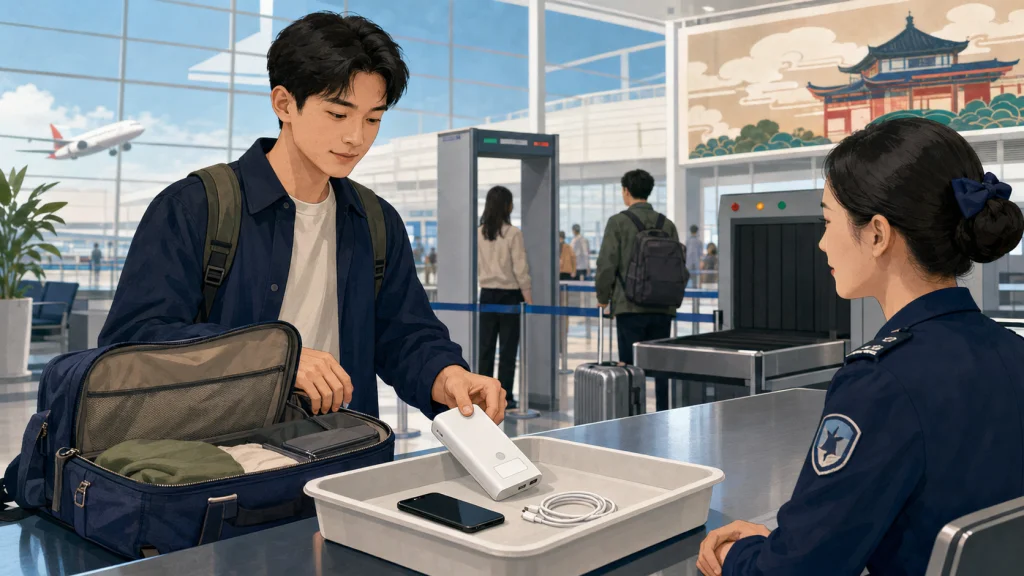
Power banks contain lithium batteries and must not be placed in checked baggage. China’s civil aviation rules also prohibit power banks above 160Wh. Airline approval and quantity limits may apply in the 100–160Wh range, so check your carrier before travel.
For domestic flights in China, the Civil Aviation Administration of China introduced an additional rule on June 28, 2025: power banks without a clear CCC mark, with an unclear CCC mark, or from recalled models and batches are prohibited. A product that was acceptable on your international flight into China may therefore fail security screening for a later Chinese domestic flight.
Do not calculate capacity from marketing language alone. Look for a legible watt-hour rating or the voltage and amp-hour data needed to determine it. Never use a swollen, damaged or recalled power bank.
Common mistakes
- Assuming an adapter changes voltage: it changes only the plug geometry.
- Checking the wrong label: read the AC input on the charger or appliance.
- Bringing a 120V hair dryer: high-power single-voltage appliances are difficult to convert safely.
- Buying the cheapest universal adapter: poor fit and weak internal contacts can create heat.
- Depending on hotel USB ports: ports may be slow, damaged or absent.
- Checking a power bank: spare lithium batteries belong in carry-on baggage.
- Ignoring domestic-flight CCC rules: these apply when flying within China.
Practical charging plan
Before departure, photograph the input labels on your chargers, test the adapter at home if possible, and consolidate around USB-C. Put the adapter and one charging cable in your carry-on. Keep a second cable separate so a single lost pouch does not disable every device.
Connectivity matters when a phone is your payment method, map, translator and ticket wallet. Pair this charging plan with our internet guide for tourists in China and China payment guide for foreign visitors.
Official sources
- China National Space Administration visitor guidance: voltage, plugs and socket outlets
- Ministry of Commerce technical guide: China’s 220V/50Hz supply
- Civil Aviation Administration of China: CCC requirements for power banks on domestic flights
- Civil Aviation Administration of China: passenger baggage and lithium-battery guidance
Final answer
Most visitors need a plug adapter, not a voltage converter. Confirm that every charger says 100–240V or otherwise includes 220V, leave single-voltage high-wattage appliances at home, and carry a reputable universal adapter. Keep power banks in hand luggage and check both their watt-hour rating and, for Chinese domestic flights, the CCC marking.