How to Use the Metro in China as a Foreigner (2026 Guide)
China’s metro systems are usually the fastest way to cross a major city, but payment methods are not identical nationwide. This guide explains the options that work most reliably for international visitors in 2026 and flags the city-specific exceptions that can save you time.
For a first ride, the lowest-risk choice is still a single-journey ticket from a machine or staffed service center. Once you know the station and line, an Alipay transport QR code can be more convenient. In Beijing and Shanghai, contactless overseas bank-card access has expanded substantially, but you should not assume that the same tap-to-ride system exists in every Chinese city.
Quick answer
- One or two rides: buy a single-journey ticket.
- Several rides in one city: activate the city’s metro QR code in Alipay or buy a local transport card.
- Beijing: overseas-issued Visa, Mastercard, JCB and American Express contactless cards are supported across the network, according to the city’s official updates.
- Shanghai: contactless foreign-card access is available across the metro network, while service centers and apps provide additional payment options.
- Other cities: check the signs or ask station staff; card acceptance and QR activation can differ.
Before your first metro ride
Install at least one map app that can search Chinese place names, save your destination in Chinese, and take a screenshot of the nearest station and exit number. A station can have a dozen exits separated by large roads or shopping complexes. Choosing the wrong exit may add a 15-minute walk even when the train journey was correct.
Also set up a payment backup. Our China payment guide explains Alipay, WeChat Pay, cards and cash, while the dedicated Alipay guide for foreigners covers identity verification and linking an international card. Keep some RMB cash because a staffed counter can solve many problems when an app or foreign card fails.
Four practical ways to pay
1. Single-journey ticket
At the station, choose your destination on a ticket machine or show the station name to staff at the service center. Depending on the city and machine, payment may include mobile payment, cash, Chinese cards or supported international cards. The Chinese government’s 2025 guide for international visitors says foreign travelers can buy single-journey tickets at station offices or self-service machines and may pay with RMB cash, mobile payment, or supported Chinese and foreign bank cards.
A single-journey token or card normally works only for the selected trip and must be inserted or returned at the exit gate. Do not throw it away after entering. If you travel beyond the fare encoded on the ticket, go to the service desk before trying random gates.
2. Alipay transport QR code
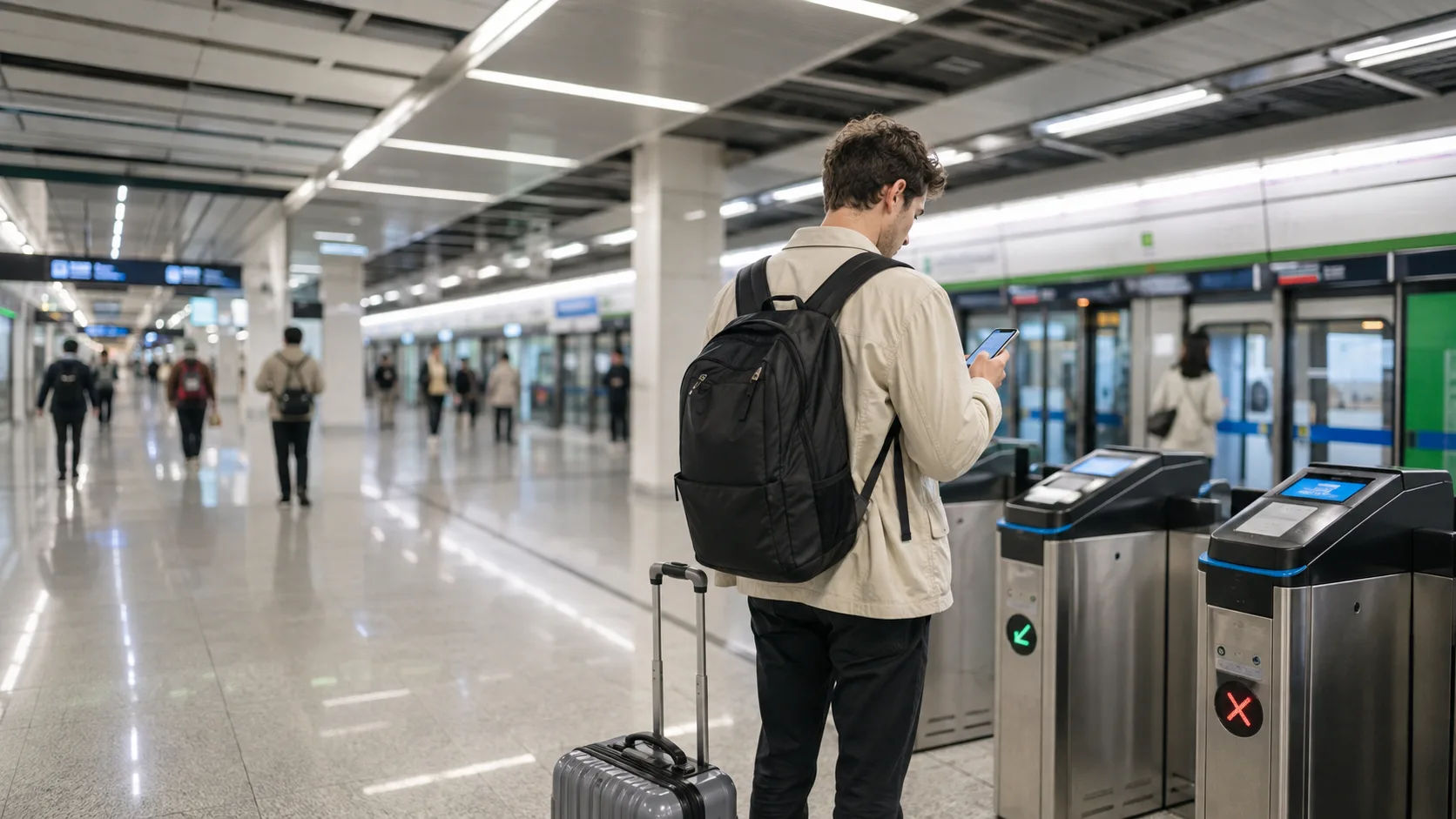
Open Alipay, select Transport, confirm the current city, and choose the metro option. Identity verification may be required before the first code is issued. At the gate, display the live transport code—not a payment collection code—and scan once when entering and again when leaving.
Transport codes are city-specific. Changing from Beijing to Shanghai, Chengdu or Guangzhou may require switching the city inside Alipay and accepting a different local transit agreement. A screenshot will not work because the code changes. Keep mobile data available underground; if the live code will not load, use a physical ticket instead of blocking the gate.
3. Contactless overseas bank card
This is now especially useful in Beijing and Shanghai, but the implementation is local rather than national. Beijing launched network-wide contactless access for overseas Visa and Mastercard cards in September 2024, then added JCB and American Express support in June 2025. The Beijing government says the five major card networks are now covered across its urban rail system.
Shanghai’s official guidance says passengers can tap supported chip-enabled UnionPay, Visa and Mastercard cards at more than 500 stations; its broader metro payment facilities also support additional card types at service centers and through relevant apps. Use the same physical card or device to tap in and out. Do not enter with the plastic card and exit with its mobile-wallet version, because the system may treat them as different payment credentials.
Even where overseas cards are advertised, carry a backup. Issuer security rules, disabled contactless payments, insufficient funds, or a damaged card can still cause a decline.
4. Physical transport card or visitor pass
A reloadable city transport card makes sense for longer stays, families, or travelers who do not want to unlock a phone at every gate. Ask at the station service center about purchase, deposit, top-up and refund rules. Bring your passport because some passes may require identification.
Beijing Pass and Shanghai Pass are designed with international visitors in mind and can be used beyond a single metro system in supported scenarios. However, coverage, refund locations and maximum balances can change. Confirm the current terms at an official counter rather than buying an unofficial card online.
How to navigate the station
- Search by station, not attraction alone. Confirm the Chinese station name and line number.
- Pass security screening. Place bags on the X-ray belt and follow staff instructions for liquids or other items.
- Choose the correct direction. Platforms are usually labeled by the terminal station or a station farther along the line.
- Stand behind the floor markings. Let passengers leave before boarding.
- Watch the station count. Trains generally announce stops in Mandarin and English in major systems, but audio can be hard to hear when crowded.
- Transfer inside the paid area. Follow the colored line signs; some interchanges require a long walk.
- Use the planned exit number. Exit numbers matter more than simply reaching the right station.
Security screening and luggage
Bag screening is routine at Chinese metro stations. Keep your passport and phone with you rather than buried under luggage. Large suitcases are usually possible, but narrow gates, stairs, long transfer corridors and rush-hour crowds make them inconvenient. Look for a wider accessible gate and ask staff for help instead of forcing a suitcase through a standard turnstile.
Rules for liquids, pressurized containers, knives, flammable materials and other restricted items are enforced locally. If you are carrying unusual equipment, camping fuel, tools, large aerosols or bulky batteries, check the operator’s current prohibited-items notice before traveling. Do not rely on airport rules as an exact substitute for metro rules.
Rush hour, etiquette and accessibility
Weekday peaks often cluster around morning commuting and the early evening, but the exact crowd pattern varies by city and line. If you have luggage, a stroller or limited mobility, traveling outside the busiest periods can make transfers much easier.
- Queue at the floor arrows and leave space for people getting off.
- Keep backpacks in front of you in crowded cars.
- Do not eat strong-smelling food or play audio aloud.
- Give priority seating to passengers who need it.
- Never hold train doors or rush a closing gate.
Many stations have elevators and accessible gates, but the most convenient elevator may be attached to only one exit. Ask staff to identify a step-free route before leaving the paid area. Families should keep children close and scan one passenger at a time unless staff direct otherwise.
Airport metro and express lines
Airport services may use a separate fare from the ordinary metro. Check the last departure time before a late arrival, and distinguish an airport express from a stopping metro line. If your flight lands near closing time, keep a backup plan using an official taxi queue or ride-hailing service. Our DiDi guide explains pickup points and payment for international visitors.
Do not assume that the fastest route on a map is practical with heavy luggage. One extra transfer can involve several elevators and long corridors. A slightly longer direct airport line may be the better choice.
Common problems and quick fixes
The QR code will not open
Check that Alipay is set to the correct city, mobile data is working, identity verification is complete, and the metro service has been activated. If the gate still rejects it, step aside and buy a ticket.
Your foreign card is declined
Confirm that contactless payments and overseas transactions are enabled. Try the staffed counter rather than repeatedly tapping. Use Alipay, cash or a single-journey ticket as backup.
You entered with the wrong payment method
If you cannot exit, do not follow another passenger through the gate. Show the card, ticket or app record to station staff. They can inspect the journey and collect any fare difference.
You boarded in the wrong direction
Get off at the next station and follow the signs to the opposite platform. In most systems you can correct the direction without leaving the paid area.
The last train has departed
Last-train times vary by line, direction, station and date. Navigation apps may lag behind temporary changes. Read the station notice early in the evening and allow time for the final transfer.
Which payment method should you choose?
| Traveler | Best starting option | Backup |
|---|---|---|
| First-time visitor taking one ride | Single-journey ticket | RMB cash |
| Visitor using the metro daily | Alipay transport QR or local card | Single-journey ticket |
| Beijing or Shanghai visitor with supported contactless card | Tap the overseas bank card | Alipay or cash |
| Family or traveler carrying luggage | Physical tickets or staffed service center | Ride-hailing for difficult transfers |
| Longer stay across several cities | Choose the local method city by city | Alipay plus cash |
Final advice
China’s metro is easy once you separate the universal steps from local payment rules. Save the station name and exit number in Chinese, keep two ways to pay, and use a single-journey ticket whenever the digital option becomes uncertain. Beijing and Shanghai now offer unusually convenient foreign-card access, but elsewhere you should treat Alipay, station machines and staffed counters as the dependable baseline.
Official sources and further reading
- State Council: Guide to Working and Living in China as Business Expatriates (2025)
- Beijing government: subway support for five major card networks
- Beijing government: overseas Mastercard and Visa access
- Shanghai government: metro contactless card access
- Shanghai government: metro ticket and bank-card options
Planning longer journeys between cities? See our China high-speed rail guide. For the full planning sequence, start with the China Travel Guide.