Best Chinese Tea Sets for Gifts (2026)
Disclosure: This guide is based on research into Chinese ceramic regions, official geographical-indication information, and practical gift-buying criteria. We do not claim to have personally tested every set mentioned. If affiliate links are added later, 7ers may earn a commission at no extra cost to you.
A Chinese tea set can be a thoughtful gift, but the phrase “Chinese tea set” covers everything from inexpensive decorative bundles to region-specific porcelain made in places with centuries of ceramic history. The difference is not simply price. A useful gift should match the recipient’s tea habits, be safe for normal use, survive shipping, and come with an honest description of where and how it was made.
This guide focuses on three of China’s best-known ceramic traditions for gift buyers: Jingdezhen porcelain, Longquan celadon, and Dehua white porcelain. It also explains when a modern Chinese-style set is the more practical choice. Our aim is not to rank imaginary “best brands,” but to help you choose a credible set for a real person and budget.
Quick recommendation: for most first-time gift buyers, choose a compact Jingdezhen porcelain gaiwan set for two to four people, with the maker or studio identified, an itemized list of pieces, clear dimensions, and protective packaging. Choose Longquan celadon for a recipient who values understated craft, and Dehua white porcelain for someone who prefers clean, sculptural design.
Quick picks by gift recipient
| Recipient or occasion | Best type | Why it works | Main caution |
|---|---|---|---|
| Beginner tea drinker | Jingdezhen porcelain gaiwan set | Neutral material, easy to use with many tea types, visually recognisable | Avoid oversized sets with many low-quality accessories |
| Design-conscious recipient | Longquan celadon set | Quiet green glaze and strong connection to a living ceramic tradition | Glaze colour varies; request current product photos |
| Minimalist or modern home | Dehua white porcelain set | Clean white body, elegant silhouette, easy to display | Pure white surfaces can reveal tea stains sooner |
| Gongfu tea enthusiast | Small gaiwan or teapot set with fairness pitcher and cups | Supports short, repeated infusions | Check vessel capacity; many Western listings omit it |
| Wedding or housewarming | Four-to-six-cup porcelain set in a fitted case | Feels complete and presentable | Packaging should protect each piece separately |
| Casual office gift | Travel tea set or mug-and-infuser set | Compact, easy to store, lower breakage risk | “Travel” sets can be too small for comfortable daily use |
What counts as an authentic Chinese tea set?
There are several legitimate meanings, and sellers often blur them:
- Made in China: the set was manufactured in China, but may have no connection to a historic ceramic region.
- Chinese-style: the shape or decoration borrows from Chinese tea culture, regardless of where it was made.
- Region-specific Chinese ceramic: the seller identifies a place such as Jingdezhen, Longquan, or Dehua and provides enough information to support that claim.
- Artist or studio work: a named maker or workshop is responsible for the piece, ideally with traceable documentation.
- Antique: an old object whose age and provenance require specialist evidence. A seal or “certificate” alone is not proof.
For most gifts, you do not need an antique or a famous-master piece. You need an honestly described modern set with a credible origin, usable dimensions, and dependable packaging. Be suspicious when a listing combines extravagant claims—“imperial,” “museum grade,” “rare clay,” “master handmade”—with a very low price and no maker, kiln, production method, or close-up images.
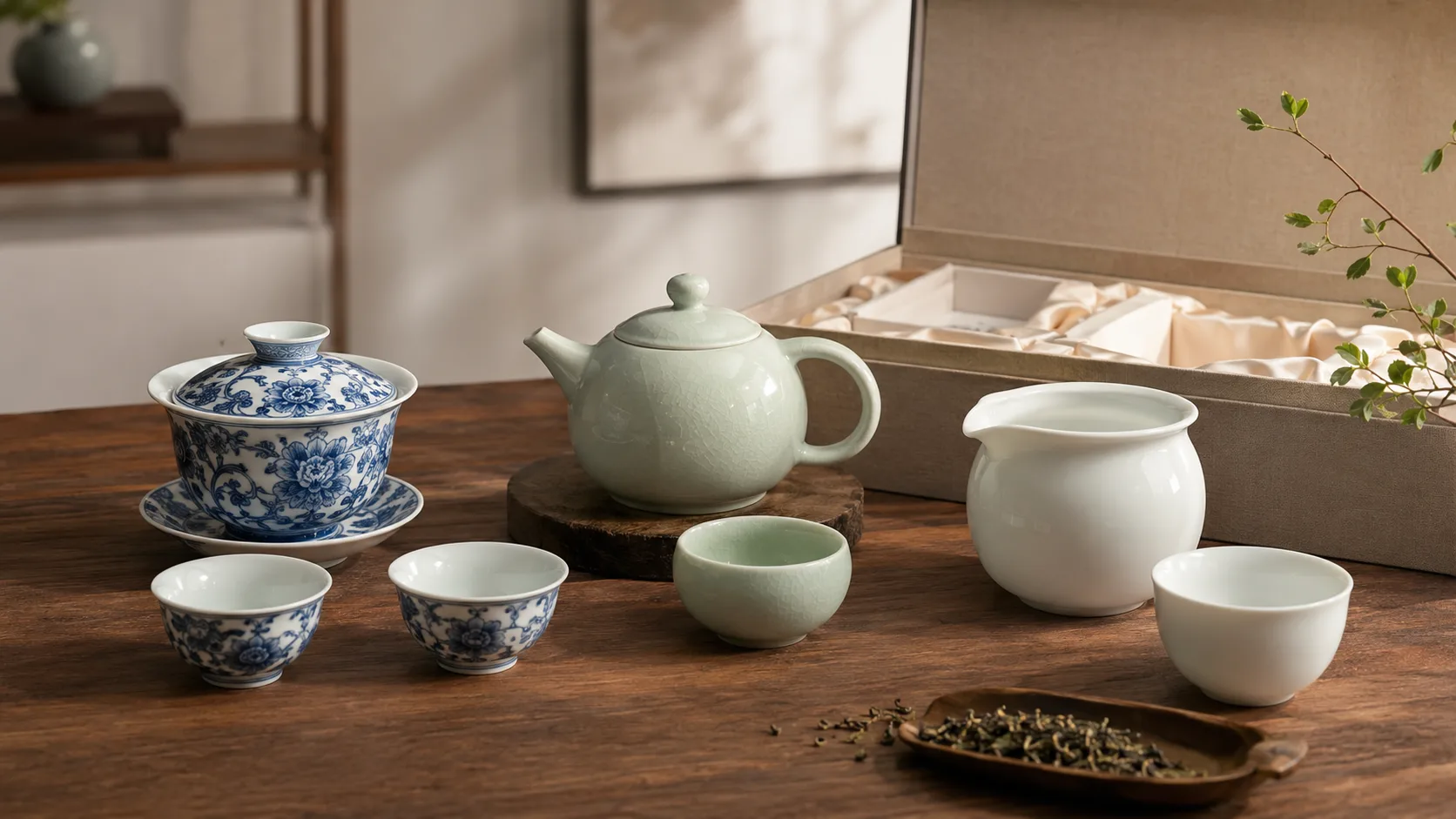
Best overall gift: Jingdezhen porcelain tea set
Jingdezhen in Jiangxi is widely known as China’s historic “porcelain capital.” The China National Intellectual Property Administration describes the geographical-indication protection area for Jingdezhen porcelain as covering the city’s administrative areas and identifies blue-and-white, linglong and famille-rose porcelain among its famous traditions.
For a gift, Jingdezhen porcelain is the most versatile option. Porcelain is relatively non-porous, so it does not retain tea aroma in the same way as unglazed clay. One gaiwan can therefore be used for green tea, white tea, oolong, black tea, and many other styles. The white interior also makes it easy to see liquor colour.
What to buy
- A 100–140 ml gaiwan for one or two serious tea drinkers.
- A teapot around 150–250 ml for a more relaxed family setup.
- Two to four cups, plus a fairness pitcher if the recipient practises gongfu-style brewing.
- Blue-and-white decoration for a classic gift; restrained contemporary decoration for a modern home.
- A named Jingdezhen studio, cooperative, or manufacturer, rather than an anonymous “Chinese porcelain” listing.
Best for: first-time buyers, weddings, housewarmings, and recipients who drink several kinds of tea.
Watch for: decals presented as hand painting, vague origin claims, gold decoration that may not be microwave-safe, and sets whose stated piece count includes trays, tongs, towels, or packaging as if they were drinking vessels.
Best craft-focused gift: Longquan celadon tea set
Longquan celadon comes from Zhejiang and is recognised for its green or blue-green glaze. UNESCO inscribed the traditional firing technology of Longquan celadon on the Representative List of the Intangible Cultural Heritage of Humanity in 2009. The process involves precise preparation, glazing, firing, and temperature control; small variations in the kiln can affect the final colour and surface.
That variation is part of the appeal. A celadon set can feel calm, tactile, and less overtly decorative than blue-and-white porcelain. It works especially well as a gift for someone interested in ceramics, architecture, minimalism, or Song-dynasty aesthetics.
What to buy
- A small covered bowl or teapot with two to four cups.
- A seller who identifies Longquan as the production location, not merely “Longquan style.”
- Close photographs of the actual glaze in natural light.
- Consistent foot finishing, stable bases, and lids that sit reasonably well.
- A simple fitted box that protects the glaze from contact with other pieces.
Best for: design lovers, ceramic collectors at an entry level, and refined business gifts.
Watch for: digitally enhanced green colour, industrial celadon-style ware sold as artisan Longquan work, and artificial crackle marketed as evidence of age. Natural variation is normal, but significant warping, sharp glaze defects, or unstable bases are not desirable for a functional gift.
Best minimalist gift: Dehua white porcelain tea set
Dehua in Fujian is famous for white porcelain, historically admired for its luminous body and sculptural qualities. China’s current national standard identifies Dehua white porcelain as a geographical-indication product, and official sources describe both sculptural and daily-use white porcelain.
A Dehua set is an excellent choice when the recipient prefers a clean, contemporary interior. White porcelain also shows the colour of tea clearly and does not compete visually with the drink. Some Dehua products are primarily decorative sculpture, however, so gift buyers should confirm that a tea set is sold for functional food-contact use.
What to buy
- A thin but not fragile white porcelain gaiwan or small teapot.
- Two to six matching cups with smooth rims.
- A contemporary Dehua studio set with clearly stated dimensions.
- A functional set rather than a decorative-only sculptural object.
- Replacement or breakage terms when ordering internationally.
Best for: minimalist homes, modern weddings, and recipients who appreciate clean product design.
Watch for: “blanc de Chine” used as a loose colour description rather than an origin claim, decorative objects not certified for beverage use, and overly thin cups that may be uncomfortable with very hot tea.
When a modern Chinese-style set is the better gift
Regional provenance is meaningful, but it is not automatically the best choice for every recipient. A durable modern set may be better for a student, office worker, frequent traveller, or someone new to loose-leaf tea. In that case, evaluate the product on honest manufacturing information, usability, and safety rather than a historic-place label.
A well-designed travel set with a 150–250 ml brewer, two cups, a drainage solution, and a hard protective case can provide more daily value than a large ceremonial set. The key is transparency: it should be described as a modern Chinese-made or Chinese-style product, not disguised as a rare regional artwork.
How to choose the right configuration
Gaiwan or teapot?
A gaiwan is versatile and lets the drinker observe leaves and control infusion time. It has a learning curve because the lid, bowl, and saucer are handled together. A handled teapot feels more familiar and may suit casual drinkers. For a complete beginner, either a medium gaiwan with heat-friendly proportions or a small glazed teapot is safer than a tiny specialist vessel.
How many cups?
Do not equate more pieces with higher value. Two or four cups suit most homes. Six cups make sense for a social household, but increase shipping weight and breakage risk. A fairness pitcher is useful for gongfu tea because it equalises infusion strength across cups. Tongs, scoops, and decorative pets are optional.
What capacity?
- 90–120 ml: focused gongfu sessions for one or two people.
- 130–180 ml: a flexible range for beginners and small groups.
- 200–300 ml: more casual sharing, but less typical for repeated concentrated infusions.
Always ask whether capacity is measured to the rim or at a practical fill level. A listing with only external dimensions is incomplete.
Glazed or unglazed?
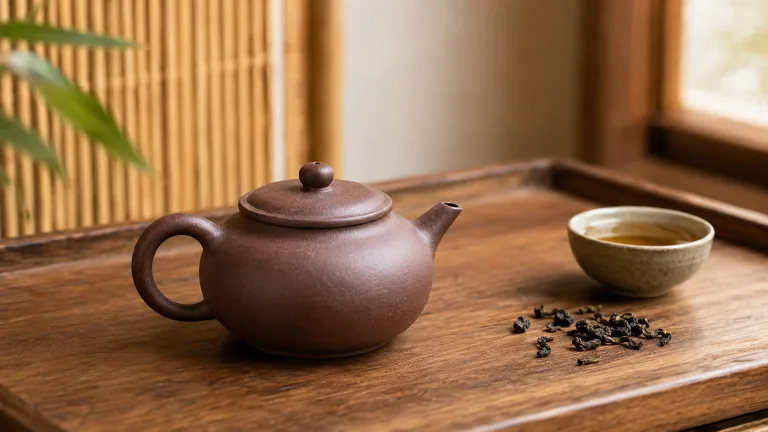
Porcelain and glazed stoneware are easiest to give because they can handle different teas without retaining much aroma. Unglazed clay is more specialised and should not be purchased only because it looks “traditional.” If the recipient wants Yixing clay specifically, use our separate beginner’s guide to Yixing teapots.
Safety and usability checks before buying
For functional ware, ask the seller whether the product is intended for food and beverage contact and which market’s compliance documentation is available. Do not assume that “lead-free,” “natural glaze,” or “food safe” text is independently verified. This matters especially with brightly coloured overglaze decoration, metallic accents, vintage pieces, and anonymous marketplace listings.
Also check:
- Whether metallic or gold decoration rules out microwave use.
- Whether the set is dishwasher-safe or hand-wash only.
- Whether the lid has a steam hole and pours cleanly.
- Whether cup rims are smooth and comfortable.
- Whether the tray is water-resistant or purely decorative.
- Whether replacement pieces can be ordered.
How to verify origin without becoming an expert
No single visual trick proves that a set is from Jingdezhen, Longquan, or Dehua. Stamps can be copied, certificates can be generic, and traditional-looking boxes can be purchased separately. Use a chain of evidence instead:
- Specific seller identity: a real business, studio, cooperative, or artist name.
- Specific production location: city or county, not just “China.”
- Consistent product information: material, technique, capacity, dimensions, and firing or decoration method.
- Current photographs: multiple angles, bases, interiors, lids, and packaging.
- Traceability: invoice, workshop documentation, geographical-indication information where applicable, and a return address.
- Plausible pricing: handmade work should not be priced like anonymous mass production.
A maker’s seal may support a story, but it should not be the entire story. Likewise, small pinholes or glaze variations can occur in kiln work; they are not automatic proof of handcraft, age, or authenticity.
International shipping and gift presentation
Ceramics fail in transit more often because of poor packing than because of the clay body. Each piece should have its own cavity or protective wrap, lids should be separated from pots, and no ceramic surfaces should knock against one another. For international orders, ask whether duties and taxes are prepaid, whether the courier offers tracking, and who pays return shipping after damage.
Wooden presentation boxes look premium but can add substantial weight. A dense foam case inside a plain outer carton may protect the gift better. If the seller offers gift wrapping, make sure it does not replace the shipping carton.
On arrival, photograph the unopened parcel and the unboxing process if the item is expensive. Inspect rims, handles, lid knobs, and foot rings before washing. Contact the seller immediately if damage is found.
Budget guide
Prices vary by maker, decoration, piece count, and sales channel, so treat the following as buying tiers rather than guarantees:
- Entry level: a functional modern set with clear specifications and modest packaging.
- Mid-range: region-identified production, better finishing, a named studio or established manufacturer, and more protective presentation.
- Premium: documented artist or workshop production, labor-intensive hand decoration, limited output, or unusually refined firing and finishing.
Spend on the vessel and its documentation before accessories. A good gaiwan and four cups are a better gift than a 20-piece bundle filled with low-value tools.
Red flags to avoid
- “Antique” or “imperial” claims without independent provenance.
- A famous artist’s name attached to a very cheap set.
- No capacity, dimensions, production location, or maker information.
- Only heavily edited lifestyle images and no photos of the actual item.
- “Handmade” used without explaining which stages are made or decorated by hand.
- Regional names used only as a style label.
- Food-safety claims with no responsible seller or supporting information.
- A high piece count that disguises a very small brewer and cups.
- No clear damage, replacement, or return policy for international shipping.
Our final recommendations
Best overall gift: a Jingdezhen porcelain gaiwan set for two to four people. It is adaptable, recognisably connected to Chinese ceramic culture, and suitable for many teas.
Best craft-focused gift: a documented Longquan celadon set from a seller who identifies the production location and provides current glaze photographs.
Best minimalist gift: a functional Dehua white porcelain set with a clean silhouette and clear food-contact information.
Best practical gift: a compact modern Chinese-made travel set with a hard case, honest materials, and replaceable parts.
The best Chinese tea set is not necessarily the largest, oldest-looking, or most expensive. Choose a set whose origin is described accurately, whose capacity matches the recipient’s habits, and whose seller takes responsibility for safety and shipping. For more region-specific recommendations, visit our Chinese Products & Buying Guides hub.
Frequently asked questions
Is Jingdezhen porcelain always handmade?
No. Jingdezhen has artisan studios, established manufacturers, and large-scale production. The place name does not by itself prove that every stage was handmade. Ask which stages—forming, painting, glazing, or firing—were done by hand.
Is Longquan celadon safe for tea?
Functional celadon from a responsible producer should be sold for beverage use, but the colour and origin name alone do not prove compliance. Ask the seller for food-contact information applicable to the destination market.
What is the difference between Dehua porcelain and generic white porcelain?
Dehua white porcelain refers to production associated with Dehua, Fujian, and is protected in China as a geographical-indication product. “White porcelain” by itself is a broad material or colour description and can be made anywhere.
Should I buy a gaiwan or a teapot as a gift?
A gaiwan is more versatile and is ideal for a curious tea drinker. A small glazed teapot is easier for someone who prefers familiar handling. For an uncertain recipient, choose a medium-size porcelain gaiwan set with comfortable proportions.
How many pieces should a gift set include?
For most people, a brewer, fairness pitcher, and two to four cups are enough. Piece count is not a quality measure, and many oversized bundles include accessories the recipient may never use.
Can a seller’s certificate prove authenticity?
Not by itself. Treat certificates, seals, and boxes as parts of a broader evidence chain that should also include seller identity, production location, consistent specifications, current photographs, and a traceable transaction.