

China 240-Hour Visa-Free Transit: Eligibility, Routes and Rules (2026)
China’s 240-hour visa-free transit policy allows eligible travelers to enter through designated ports, remain within approved areas for up to 10 days and continue to a third country or region. It is a transit policy, not a general visa waiver: the route before and after mainland China is central to eligibility.
As of 20 August 2026, the policy covers nationals of 57 countries, 65 entry ports and permitted areas in 24 provincial-level regions. Kyrgyzstan and Vietnam were added on 20 August 2026 (NIA Announcement No. 4 of 2026). The official lists can change, so verify the current National Immigration Administration information before booking.

Quick answer
China’s 240-hour visa-free transit policy is available to travelers from 57 eligible countries who pass through mainland China on the way to a different third country or region. Entry must be through one of 65 designated ports, travel must remain within the permitted areas, and the traveler needs confirmed onward arrangements within 240 hours.
Quick decision
- Route A → mainland China → B: may qualify when A and B are different countries or regions.
- Route A → mainland China → A: does not satisfy the third-destination transit rule.
- Changing cities in China: allowed only when every stop is inside the policy’s permitted areas.
- Unclear airline or ticket arrangement: confirm before departure; border entry remains subject to immigration inspection.
Contents
- Eligibility and nationalities
- Third-country route rule
- How the 240 hours are calculated
- Ports and permitted areas
- Documents and arrival process
- Itinerary changes and common mistakes
- Pre-booking checklist
- FAQ
Who can use the 240-hour visa-free transit policy?
You need to meet all of the core conditions:
- Hold nationality from one of the 57 eligible countries.
- Carry a valid international travel document.
- Transit from one country or region through mainland China to a different third country or region.
- Hold a confirmed onward ticket with a specified departure date and seat.
- Enter through one of the 65 designated ports.
- Remain within the permitted stay area for your entry port.
- Leave within the authorized 240-hour period.
The immigration inspection authority makes the entry decision at the port. Meeting the general description does not guarantee admission if documents, route or purpose do not satisfy the rules.
The 57 eligible nationalities
The National Immigration Administration currently lists:
Europe: Albania, Austria, Belarus, Belgium, Bosnia and Herzegovina, Bulgaria, Croatia, Cyprus, Czech Republic, Denmark, Estonia, Finland, France, Germany, Greece, Hungary, Iceland, Ireland, Italy, Latvia, Lithuania, Luxembourg, Malta, Monaco, Montenegro, the Netherlands, North Macedonia, Norway, Poland, Portugal, Romania, Russia, Serbia, Slovakia, Slovenia, Spain, Sweden, Switzerland, Ukraine and the United Kingdom.
North America: Canada and the United States.
South America: Argentina, Brazil, Chile and Mexico.
Oceania: Australia and New Zealand.
Asia: Brunei, Indonesia, Japan, Kyrgyzstan, Qatar, Singapore, South Korea, the United Arab Emirates and Vietnam.
Eligibility is based on the passport presented, not residence, departure city or possession of another country’s visa.
The “third country or region” rule
Your itinerary must show genuine international transit. Country or region A → mainland China → country or region B generally fits when A and B are different.
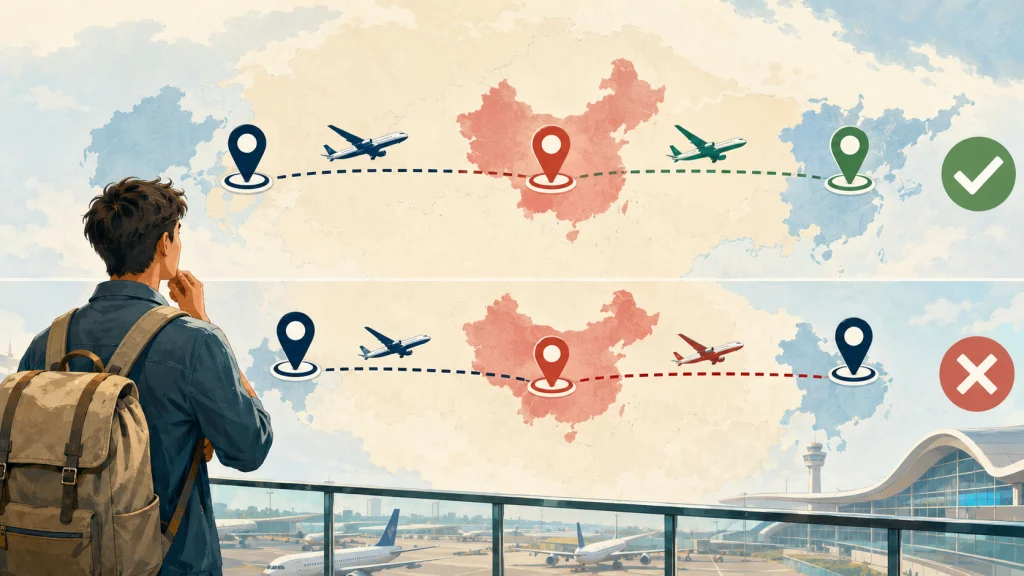
Routes that normally illustrate the rule
- United States → Shanghai → Japan
- United Kingdom → Beijing → South Korea
- Australia → Guangzhou → Hong Kong
- Hong Kong → Shenzhen → Singapore
A route that does not illustrate the rule
United States → Shanghai → United States is a round trip, not transit to a third country or region. Adding a domestic connection does not change the international origin and final destination.
Hong Kong, Macao and Taiwan are treated as separate regions for this transit-routing purpose. The complete ticket sequence matters, including separate bookings and connections.
Do separate tickets qualify?
The published rule requires an onward ticket with a confirmed seat and departure date. It does not say every flight must be on one booking. However, separate tickets create practical risk: the airline at origin and immigration officer must be able to verify the complete route, and a missed connection is your responsibility.
Carry printed or offline confirmations for every segment. If the onward carrier does not assign seats until check-in, keep evidence of the confirmed booking and ask the airline and the Chinese immigration service whether additional documentation is advisable.
How the 240 hours are calculated
Under the National Immigration Administration’s November 2025 announcement, the visa-free stay period is calculated from 00:00 on the day following entry. This can provide slightly more elapsed time than exactly ten 24-hour periods from the arrival moment.
Do not design an itinerary around the last possible minute. Use the authorized-until date written or confirmed by immigration officials and leave a margin for weather, schedule changes and transport to the departure port.
Where can you enter?
The policy applies only at designated ports. As of August 2026, there are 65 eligible ports in 24 provinces, autonomous regions and municipalities. They include major airports and selected rail, road and sea ports.
Five Guangdong ports were added effective 5 November 2025: Guangzhou Pazhou Ferry Terminal, Hengqin Port, the Hong Kong–Zhuhai–Macao Bridge Port, Zhongshan Passenger Port and West Kowloon Station Port on the Guangzhou–Shenzhen–Hong Kong Express Rail Link.
Do not assume every international airport, land border or railway crossing can process a 240-hour entry. Check the official port table for the exact arrival point shown on your ticket.
Where can you travel after entry?
You must stay within the permitted area attached to the policy and port. The allowed area is not automatically the whole country. Some regions permit travel across several neighboring provincial-level areas, while others are more limited.
Verify every city on the itinerary against the NIA’s current “Eligible Ports and Permitted Stay Areas” table. A domestic train or flight can still violate the policy if it takes you outside the approved area.

7ers Tip: Put the inbound itinerary, onward booking, hotel address and a screenshot of the NIA port-and-area table in one offline folder. Airline staff and immigration officers need to understand the complete route, not just the China segment.
Documents to prepare
- Eligible passport or international travel document
- Confirmed onward international ticket with date and seat information
- Booking for the first accommodation
- Address and phone number of the accommodation in Chinese
- Complete itinerary showing the country or region before and after China
- Evidence supporting the visit purpose, such as tourism or business arrangements
- Offline copies of all bookings

Keep the documents accessible during airline check-in and arrival immigration. A reservation stored only in an online account is not useful when mobile data fails.
What happens at the departure airport?
Tell the airline that you intend to use China’s 240-hour visa-free transit policy. Airline staff must check whether you appear eligible to board, so allow extra time and show the complete onward itinerary.
If staff are unfamiliar with the policy, provide the official National Immigration Administration page rather than relying on a travel-blog screenshot. The final temporary-entry decision belongs to Chinese immigration authorities.

Arrival procedure in China
- Follow signs for visa-free transit or temporary entry services where available.
- Present the passport and confirmed onward itinerary.
- Complete the arrival card through official channels or at the port as instructed.
- Answer questions about the route, accommodation and visit purpose.
- Confirm the permitted stay area and authorized departure deadline.
China introduced official online arrival-card filing channels in November 2025. The filing service is free. Use only the NIA website, government platform, NIA 12367 app or official mini-program/port channels; the NIA has warned about fraudulent sites charging travelers.
Accommodation registration
Hotels normally register foreign guests during check-in, so show the same passport used at immigration. If you stay in a private residence or accommodation that does not register you automatically, follow the local registration procedure. Participating areas may offer online accommodation registration, but availability varies.
Confirm before booking that the property can process a foreign passport, especially for a late arrival or small guesthouse.
What activities are permitted?
The NIA says eligible visitors may engage in tourism, business, visits, family reunions and similar activities within the permitted area. Work, study and news reporting that require prior approval remain subject to the appropriate visa and authorization.
If the real purpose is employment, formal study or another regulated activity, obtain the proper visa instead of trying to fit the trip into transit rules.
Can you leave from a different port?
The policy allows eligible travelers to enter through designated ports and travel within approved areas, but the exit route must still comply with the current port and area rules. Confirm that the planned departure port is eligible for your itinerary and reachable without leaving the permitted area.
An open-jaw itinerary can be practical—for example, entering through one approved airport and leaving through another—but verify the specific regional rules before ticketing.
What if the onward flight changes?
Contact the airline and local immigration authority immediately if a cancellation or medical emergency may cause an overstay or route change. Keep written evidence. Do not simply remain beyond the authorized period or travel outside the permitted area.
The China Immigration Service Hotline is 12367 inside China. International access and language support can vary, so also keep the contact details for the port and your airline.
240-hour transit versus 24-hour transit
China’s 24-hour visa-free transit policy applies more broadly at open ports for travelers continuing to a third country or region, provided they remain within the restricted port area. Leaving that area requires a temporary entry permit from immigration.
The 240-hour policy is different: it is limited to listed nationalities and designated ports but permits eligible visitors to enter and travel within specified areas for up to 10 days.
Common mistakes
- Booking a round trip instead of a route to a third country or region
- Arriving at a port not on the eligible list
- Planning travel outside the permitted area
- Holding an onward reservation without a confirmed date or seat
- Confusing unilateral visa-free entry with visa-free transit
- Relying on an outdated list of 60 ports or 54 countries
- Assuming the stay ends exactly 240 hours after landing
- Using a paid imitation arrival-card website
Pre-booking checklist
- Confirm that your passport nationality is on the current NIA list.
- Build a clear A → China → B international itinerary.
- Check the exact entry and exit ports.
- Verify every planned city is within the permitted area.
- Keep confirmed onward tickets and accommodation details.
- Ask the airline about boarding-document requirements.
- Recheck the official policy shortly before departure.
For payments, mobile data, hotels and arrival preparation, use our first-trip-to-China checklist. For domestic rail within an approved area, see the China high-speed rail guide.
Frequently asked questions
Does Hong Kong or Macao count as a third country or region?
For this transit route rule, Hong Kong and Macao are treated as separate regions from mainland China. A route such as an overseas country → mainland China → Hong Kong may satisfy the onward-destination condition if all other requirements are met.
Can I use a return ticket to the country I came from?
Not as the onward segment for the same transit. The destination after mainland China must be different from the country or region immediately before mainland China.
When does the 240-hour period start?
The NIA states that the visa-free stay is calculated from 00:00 on the day after entry. Do not plan to use every theoretical hour; allow margin for transport changes and exit formalities.
Can I take domestic trains or flights during the stay?
Domestic travel may be possible within the policy’s designated permitted areas. The approved geography varies by entry port and region, so check every planned stop against the current NIA table before booking.
Is approval guaranteed if I meet the published conditions?
No. Travelers apply at immigration inspection, and admission remains subject to review by the competent authorities. Airlines may also check documentation before boarding.
References
- National Immigration Administration: visa-free transit policies and country list
- National Immigration Administration: 65 ports, conditions and stay calculation
- Chinese government: Visit China portal
Reviewed and updated: 20 August 2026. Immigration rules can change and entry decisions rest with the competent authorities. Verify the current NIA policy and your complete itinerary before travel. See the 7ers Editorial Policy.