
How to Order Food in China Without Speaking Chinese (2026)
Learning how to order food in China without speaking Chinese is less about memorizing a long phrase and more about building a simple routine: choose a restaurant with a readable menu, show the exact dish, confirm important ingredients, check the quantity and keep a backup way to pay.
Picture menus, QR ordering and translation apps make the process manageable in most cities. The difficult situations are usually ambiguous pickup details, shared portions and dietary restrictions—not the absence of fluent Chinese.
Quick answer
You do not need fluent Chinese to order food in China. Choose a restaurant with pictures or item numbers, point to the exact dish, confirm quantity and spice level, and use a translation app for one short request at a time. For allergies, use a professionally translated card and ask the restaurant directly.
Quick decision
- Easiest first meal: a mall, hotel, station or busy tourist-area restaurant with a picture menu.
- Using a QR menu: check table number, options, quantity and whether payment is required before submitting.
- Serious allergy: do not rely on camera translation alone; confirm ingredients and cross-contact before ordering.
- Payment: prepare Alipay or WeChat Pay and carry cash or a bank card as backup.
Contents
- Common ordering systems
- Translation tools and useful characters
- Allergies and dietary needs
- Payment and delivery
- Ordering checklist
- FAQ
Choose the easiest restaurant for your first meal
Restaurants in shopping centres, hotels, transport hubs and busy tourist areas are more likely to have picture menus, item numbers or digital ordering. Small neighbourhood restaurants can be excellent, but the menu may be entirely in Chinese and staff may have little experience with foreign-language requests.
Before sitting down, look for three useful signals: prices are displayed, dishes have photos, and the restaurant is busy enough that food is moving through the kitchen. For the first meal after a long flight, a straightforward noodle, dumpling or rice restaurant is easier than a large hotpot or banquet menu.
Understand the four common ordering systems
Printed menu and waiter
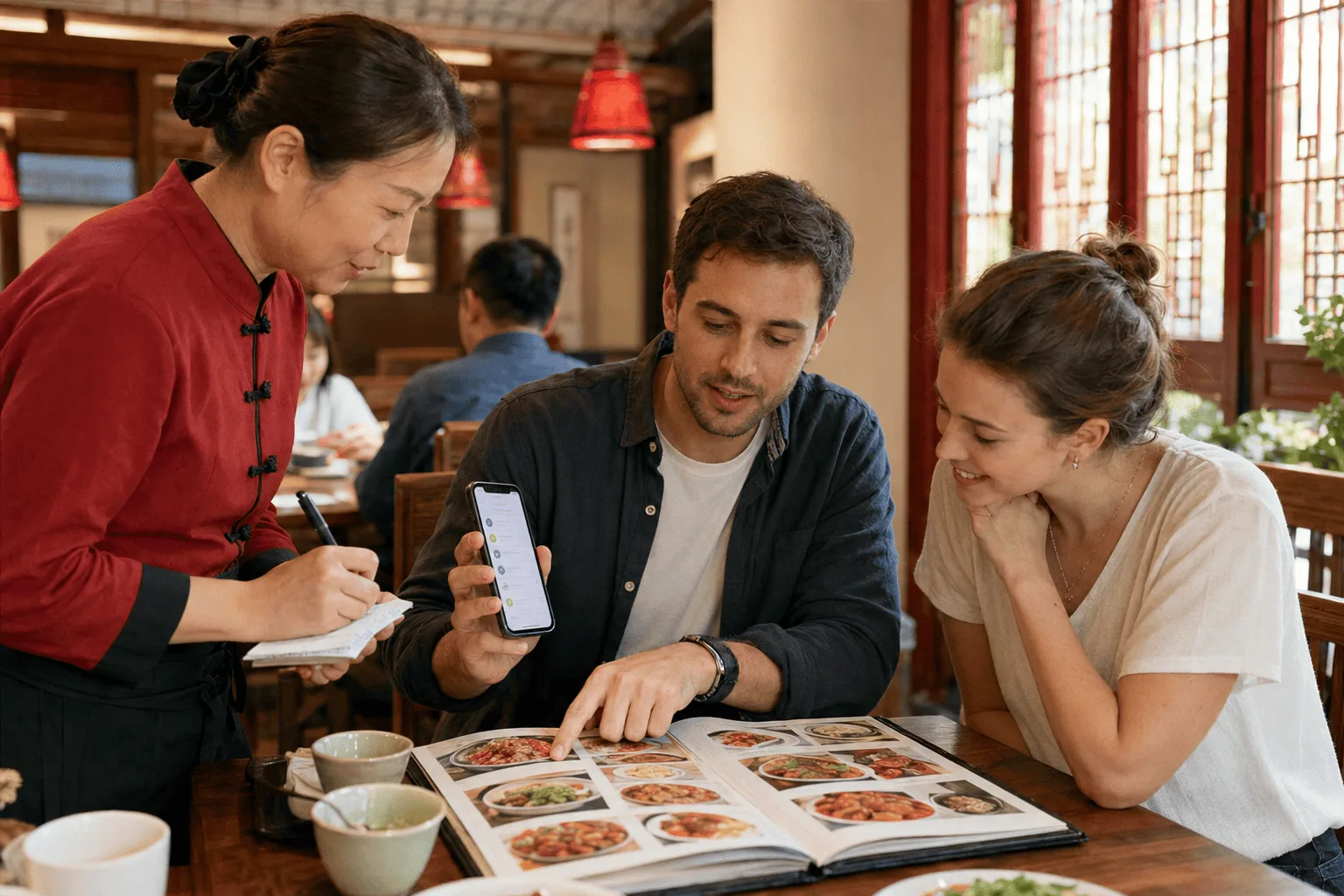
Point to the dish, state the quantity and show any translated request. If each item has a number, use it. Keep the menu open until the waiter repeats or marks the order.
QR code at the table
Scan the table code with the phone camera, WeChat or Alipay as instructed. The page may open a mini program, ask for a table number and show options for size, spice, toppings or quantity. Review the basket before submission; one accidental tap can add several portions.
A restaurant QR code may open ordering only, with payment completed later at the cashier. In other restaurants, payment is required before the kitchen receives the order. Do not assume a payment screen means the order was already placed.
Counter ordering
Fast-food, bakery, drink and snack shops often take orders at the counter. Point to the display, confirm the size and pay before collection. Keep the receipt or order number.
Choose-from-display restaurants
Some canteens and small restaurants let diners point to prepared dishes. Ask whether the displayed price is per portion, by weight or for a set meal. A photograph on your phone can help staff identify what you want.
Use translation tools effectively
Translate one short question at a time. A paragraph containing several conditions is easy to misunderstand. Show the Chinese output and allow the staff member to type or speak a reply into the same app.
Useful questions include:
- Does this contain peanuts?
- Does this contain pork?
- Can this be made without chilli?
- Is this one portion?
- Is rice included?
- Can we order this for two people?
Use the camera-translation function for printed menus, but treat its output as a clue rather than a guarantee. Dish names can be poetic, regional or unrelated to the literal ingredients.
Useful Chinese characters to recognize
- 辣 / 不辣 — spicy / not spicy
- 微辣 — mildly spicy
- 猪肉 — pork
- 牛肉 — beef
- 鸡肉 — chicken
- 鱼 — fish
- 虾 — shrimp
- 花生 — peanut
- 米饭 — rice
- 面 — noodles
- 热 / 冰 — hot / iced
- 堂食 / 外带 — eat in / take away
- 买单 — request the bill
Showing the characters on your screen is often clearer than attempting pronunciation in a noisy room.
Confirm portion size before ordering
Many Chinese meals are designed for sharing. A photo rarely shows scale, and “one dish” may be enough for several people. Ask how many diners the dish serves, especially for whole fish, hotpot ingredients, large bowls and banquet-style plates.
A sensible approach for two diners is to start with two or three items, then add more. In a QR menu, check whether the quantity is dishes, skewers, individual pieces, grams or sets.
Spice level is not a universal scale
“Mild” depends on the cuisine and restaurant. Sichuan and Hunan dishes may contain chilli even when the main photo looks plain. If spice matters, show both the request and the dish to staff before submitting the order.
不辣 means “not spicy,” while 微辣 means “slightly spicy.” A kitchen may not be able to remove chilli from a sauce or prepared base. Choose a naturally non-spicy dish rather than expecting every recipe to be modified.
Food allergies require more than an app translation
For a serious food allergy, prepare a professionally translated card that names the allergen, explains that cross-contact matters and states what action is required. Show it before ordering and ask whether the kitchen can accommodate the restriction.
Do not assume that removing visible nuts, seafood or another ingredient makes a dish safe. Shared oil, sauces, utensils and preparation areas can create cross-contact. Research cited by the U.S. CDC found that dedicated equipment and preparation areas are important restaurant safeguards, but they are not universal.
If staff cannot give a clear answer, choose another restaurant or a simpler packaged option with readable ingredients. Carry prescribed emergency medication and follow the plan provided by your clinician. Translation software alone is not a safety guarantee.
Vegetarian, vegan, halal and religious restrictions
Specify the exact ingredients you avoid. “Vegetarian” can be interpreted differently, and a vegetable dish may use meat stock, lard, oyster sauce or small pieces of meat. A direct list—no meat, fish, seafood, animal stock or egg, for example—is clearer than one label.
For halal food, look for 清真 and confirm the restaurant’s current certification or practices when that is important to you. Do not rely only on a dish name or green sign.
Hotpot and shared-table meals
Hotpot usually requires choosing a broth, meat and vegetables separately. The menu may price ingredients per plate rather than as a complete meal. Confirm whether the broth, dipping sauce, tea or tableware carries an additional charge.
If someone at the table has an allergy or dietary restriction, a divided pot does not necessarily prevent cross-contact because utensils, splashes and shared preparation may mix ingredients.
7ers Tip: Take a screenshot of the dish and table number before submitting a QR order. If the page closes or payment fails, staff can see exactly what you were trying to order.
Paying for the meal
Some restaurants take payment at the table; others expect you to bring an order slip to the cashier. Mobile payment is common, but China’s official visitor guidance confirms that international visitors can also use bank cards and cash in supported situations.
Set up Alipay or WeChat before the meal and carry a second method. Our guide to paying in China covers international cards, fees and troubleshooting.
Before paying, check the table number, quantities and any automatically added items. If a QR page fails, show staff the screen rather than submitting the basket repeatedly.
Ordering takeaway and food delivery
For takeaway at the restaurant, use 外带. For delivery, major apps list nearby restaurants, menus and delivery fees. The Shanghai government’s guide explains the basic workflow: open the food-delivery section, choose a restaurant, add items to the cart, enter the delivery details and submit payment.
The hardest part is the address. A Chinese phone number, building name, gate, room number and delivery note may be required. Hotel guests should ask reception whether riders can enter the building or must meet outside. Do not order to a large station or attraction unless you know the precise collection point.
Basic food-safety habits
Choose food that is cooked thoroughly and served at the proper temperature. The U.S. CDC advises diners to eat hot foods hot and cold foods cold, and to be cautious with raw or undercooked meat, poultry, seafood and eggs. Wash or sanitize hands before eating.
For leftovers, ask the restaurant to pack them promptly and refrigerate them when appropriate. Avoid carrying perishable dishes for a long day without temperature control.
A simple ordering checklist
- Select a restaurant with a menu you can interpret.
- Photograph or point to the exact dish.
- Confirm quantity, portion and spice level.
- State dietary restrictions one at a time.
- Review the QR basket or written order.
- Confirm whether payment is now or after the meal.
- Keep the receipt or order number until everything arrives.
Frequently asked questions
Can I order food in China without WeChat?
Usually, yes. Many restaurants accept orders through a printed menu, at the counter or with help from staff. Some table QR systems open in WeChat or Alipay, so having at least one of those apps makes the process easier.
Do restaurants in China have English menus?
Some hotels, malls and tourist-area restaurants do, but many local restaurants do not. Pictures, item numbers and camera translation are often more useful than expecting a complete English menu.
How do I ask for food that is not spicy?
Show 不辣 (not spicy) and point to the dish. Some sauces and soup bases are prepared in advance, so choosing a naturally non-spicy dish is safer than asking a spicy recipe to be changed.
Is cash accepted in Chinese restaurants?
Cash remains legal tender, although mobile payment is more convenient in many restaurants. Carry smaller notes and a second payment method because staff may not always have change.
References
- Shanghai government: how to use food-delivery apps
- Chinese government: Guide to Payment Services in China
- CDC: food-safety tips for dining out
Reviewed and updated: 1 August 2026. Menus, payment flows and app interfaces vary by restaurant. Serious allergies require direct confirmation and a personal medical plan. See the 7ers Editorial Policy.