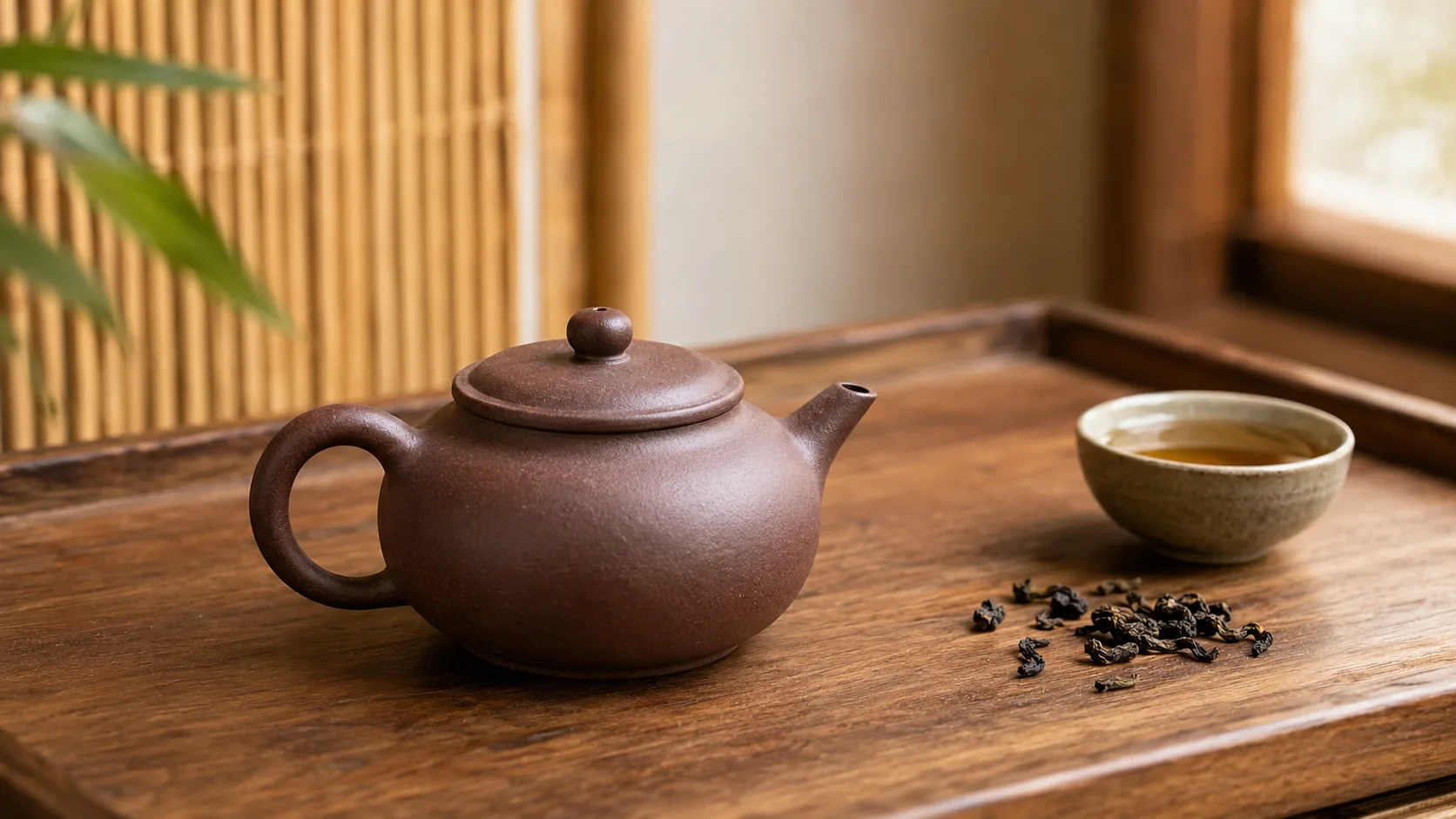
Best Yixing Teapots for Beginners (2026)
Disclosure: This guide is independently researched. Some links may become affiliate links, which means we may earn a commission at no extra cost to you. We do not claim hands-on testing where none was performed. Prices and stock can change.
Buying your first Yixing teapot is harder than it should be. Search results mix genuine Yixing zisha, mass-produced clay pots, slip-cast lookalikes, modern studio work, and expensive pieces carrying famous seals that may prove nothing. A beginner can easily spend too little on a fake—or far too much on a story.
The safest first purchase is not a “masterpiece.” For most beginners, it is a functional 100–120 ml half-handmade zini or hongni teapot from a seller that clearly discloses the clay, construction method, actual capacity, maker or studio, and return policy. That specification is practical for gongfu brewing, affordable relative to fully handmade work, and easier to evaluate than a vintage or celebrity-signed pot.
Quick answer: the best first Yixing teapot
- Best overall type for most beginners: 100–120 ml, half-handmade zini, simple shuiping or similar balanced shape.
- Best for aromatic oolong and hongcha: 90–110 ml hongni or zhuni-style pot from a seller with unusually clear clay documentation.
- Best value strategy: buy modern, functional studio work—not a “famous master” name or supposed antique.
- Best authenticity signal in China: when available, verify the official “Yixing Zisha” geographical-indication mark and its unique traceability code.
Our recommendation: prioritize documented provenance and brewing function over decorative carving, certificate theatrics, seal names, or dramatic claims about rare clay.
Quick decision table
| Buyer | Recommended first pot | Why | Avoid |
|---|---|---|---|
| New to gongfu tea | 100–120 ml half-handmade zini | Versatile, forgiving, sensible entry point | Very tiny pots, antiques, “master” premiums |
| Mostly yancha or dancong | 90–110 ml hongni; simple shape | Good heat and practical leaf movement | Buying by clay color alone |
| Mostly young green tea | Porcelain gaiwan first | Neutral and easier to control at lower temperatures | Buying Yixing merely because it looks traditional |
| Collector | Documented artist or vintage work | Provenance matters more than beginner utility | Unverified seals and marketplace certificates |
What counts as a real Yixing teapot?
“Yixing teapot” should mean more than a reddish-brown unglazed pot. China’s geographical-indication definition ties Yixing zisha ware to the present administrative area of Yixing, Jiangsu, and to zisha mineral material from that area. The principal clay families include zini (purple clay), hongni (red clay), and benshan lüni (local green clay). Genuine work is traditionally formed from prepared clay slabs rather than thrown like ordinary wheel-made pottery.
In late 2025, Yixing launched an updated geographical-indication certification system supported by a “one pot, one code, one image, one report” traceability mechanism. A certified piece can be linked to reviewed information such as clay origin, making method, and maker qualifications. In 2026, the local government also described NFC-linked traceability for participating brands on JD.com.
This is important—but do not reverse the logic. A valid official code is strong evidence for a participating certified product. The absence of that new label does not automatically prove that every older or independently sold teapot is fake. The system is a useful verification path, not a magic test for the entire global secondary market.
7ers tip: Ask the seller to state four things in writing: where the clay comes from, whether the pot is half- or fully handmade, who made it or which studio produced it, and the measured capacity. Vague answers are more revealing than a polished certificate.
Best Yixing teapot choices for beginners
1. A 100–120 ml half-handmade zini pot — best overall
This is the least glamorous recommendation and the most useful one. Zini is the broad purple-clay family most people associate with Yixing. A simple, medium-thickness pot in the 100–120 ml range is large enough for one or two gongfu drinkers, small enough to use a sensible leaf-to-water ratio, and less specialized than a tiny thin-walled zhuni pot.
Half-handmade means a mold helps form the body consistently, while significant assembly and finishing remain manual. It is not the same as slip casting, and it is not automatically inferior. For a first pot, good clay preparation, clean joins, a reliable lid, a comfortable handle, and a controlled pour matter more than paying a large premium for fully handmade construction.
Best for: drinkers exploring roasted oolong, aged white tea, hongcha, shou puer, or aged sheng puer without wanting a highly specialized first vessel.
2. A 90–110 ml hongni pot — best for a more responsive everyday pot
Hongni is a red-clay family. A straightforward hongni shuiping-style pot can be a good choice for yancha, dancong, hongcha, and puer, depending on the specific clay processing, wall thickness, firing, and shape. For a beginner, the advantage is not mystical “tea transformation.” It is a manageable size, familiar geometry, and a category with many functional modern examples.
Do not buy solely because a listing says “dahongpao” or displays a vivid red color. Clay-family names are used inconsistently in online marketing, and color can be influenced by mineral composition, processing, firing atmosphere, and photography.
Best for: buyers who already know they enjoy gongfu brewing and want a compact pot for darker or highly aromatic teas.
3. A documented modern studio pot — best value approach
A current studio pot with transparent production details is usually a safer beginner purchase than a supposed antique or a pot bearing a celebrated historical seal. Modern sellers can disclose the maker, clay batch, construction, capacity, pour behavior, and return terms. An old-looking patina or famous stamp can be reproduced; a coherent chain of provenance is harder to fake.
Current specialist listings show the practical price spread. Half-handmade pots with disclosed clay and capacity often sit in roughly the low-hundreds to mid-hundreds of US dollars, while fully handmade and collectible examples can climb much higher. Price alone never authenticates a pot, but a new “fully handmade, rare-clay, master-made” teapot at a souvenir price should trigger skepticism.
4. A porcelain gaiwan — best choice for some “Yixing beginners”
If you mainly drink green tea, delicate white tea, or many unrelated tea styles, the best first purchase may not be Yixing at all. Unglazed clay can interact with aroma and is commonly dedicated to a narrower tea family. A porcelain gaiwan is neutral, inexpensive, and lets you learn water temperature, ratio, and infusion timing before adding another variable.
Who this article is not for: anyone looking for a guaranteed investment, instant antique authentication, or a single pot that will improve every tea. Yixing is functional teaware first; collectible value requires deeper expertise and provenance.
How to assess authenticity without believing internet myths
Start with provenance, not “tests”
The strongest beginner evidence is documentary and commercial: a known seller with a long record, a precise product description, disclosed construction, a named maker or studio, consistent photos, realistic pricing, and a return policy. For certified products in China, check the geographical-indication mark and traceability record against the physical pot.
Inspect construction and function
A useful teapot should feel balanced when filled. The lid should sit cleanly, although perfect vacuum-like tightness is not a universal authenticity requirement. The handle should give safe control, the spout should pour without severe dribbling, and the interior should match the claimed construction method. Ask for a measured capacity rather than relying on a nominal number.
Treat seals and certificates as supporting evidence
A base seal can identify a maker only when the attribution is independently credible. A famous name stamped into clay is easy to copy. Likewise, a seller-produced certificate is not the same as verified provenance. Compare the maker, studio, invoice, traceability data, and pot itself as one evidence set.
Do not rely on sound, smell, or color alone
Online advice often claims that a genuine pot must ring at a certain pitch, absorb water instantly, smell like earth, have a perfectly tight lid, or display one “correct” color. These observations can describe some pots, but none independently proves clay origin. Firing, wall thickness, shape, moisture, mineral blend, and surface treatment all affect the result.
Zini, hongni, zhuni, and duanni: a beginner’s map
| Clay term | General character | Beginner use | Buying caution |
|---|---|---|---|
| Zini | Purple-brown family; broad and variable | Most versatile starting point | “Zini” alone says little about source or processing |
| Hongni | Red-clay family | Good compact everyday option | Do not infer quality from bright red color |
| Zhuni | Fine, sought-after red-clay category | Better after you know your tea and preferences | Heavily overused marketing term; high fake-claim risk |
| Duanni | Yellow, beige, or light-toned family/blends | Can suit experienced buyers seeking a specific effect | Light color is not proof of benshan lüni or rare clay |
Clay names do not operate like standardized model numbers. Natural ore, blending, aging, processing, firing temperature, and atmosphere can produce substantial variation. A responsible seller should explain what its terminology means rather than using a rare-sounding name as the entire sales pitch.
Half-handmade vs fully handmade vs mass-produced
Fully handmade usually means the body is formed from clay slabs without a shaping mold. It demands more labor and skill, but the label does not guarantee excellent clay, proportions, or pour.
Half-handmade uses a mold to assist body formation and consistency, with manual assembly and finishing. For functional modern teaware, this can offer the best balance of price, repeatability, and craft.
Wheel-thrown, machine-pressed, or slip-cast products may be perfectly usable clay teapots, but sellers should not present them as traditional handmade Yixing work. The problem is misrepresentation, not the existence of affordable production methods.
Yixing’s own government has acknowledged online-market confusion between fully handmade, half-handmade, wheel-made, slip-cast, and imitation work, as well as false claims about local clay and famous makers. That is why disclosure matters more than romantic language.
Choose size and shape before chasing rare clay
- 70–90 ml: solo sessions and experienced users comfortable with concentrated ratios.
- 100–120 ml: the beginner sweet spot for one or two people.
- 130–160 ml: useful for two or three drinkers or more casual brewing.
- Over 180 ml: often cumbersome for high-leaf gongfu sessions.
Simple shapes are easier to evaluate and clean. Shuiping, pear, and compact round forms usually offer predictable handling. Long leaves such as yancha and dancong may benefit from a wider opening or broader body. Compressed puer chunks need room to expand. Decorative sculptural pots can be beautiful, but complex lids, awkward handles, and narrow openings are poor beginner trade-offs.
Also check the filter. Traditional single-hole spouts can pour beautifully but may clog with broken leaf. Multi-hole or ball filters are more forgiving, though the filter style alone does not identify age or authenticity.
Seven red flags when buying online
- “Rare old clay” with no traceable source. A dramatic mine name is not documentation.
- A famous master’s seal at an implausibly low price. Buy the pot, not the stamp.
- Every pot is described as fully handmade. Ask what specific forming method was used.
- No interior, base, lid, spout, or scale photos. Beauty shots cannot show construction.
- No measured capacity. Listing dimensions alone are not enough for brewing.
- Absolute claims from a single home test. Sound, color, water absorption, and lid fit are not definitive.
- No return path for damage or misdescription. International ceramic shipping adds real risk.
What should a beginner expect to pay?
There is no official universal price floor. As of August 2026, examples from established specialist sellers put many documented modern half-handmade pots around roughly US$120–250, with fully handmade, scarce-clay, artist, and vintage pieces extending from several hundred dollars to far more. Inventory is small and prices move, so treat this as a market snapshot—not a guarantee.
Below about US$50, assume you are buying a general clay teapot unless the seller provides unusually strong evidence otherwise. That pot may still brew tea, but the listing should not ask you to pay for an unsupported Yixing story. At the other extreme, beginners do not need a four-figure pot to experience gongfu tea.
How to season and care for a Yixing teapot
- Rinse thoroughly with clean hot water. Remove dust; avoid harsh detergents unless the maker specifically instructs otherwise.
- Inspect for odors or residues. A persistent chemical or perfume smell is a reason to stop and contact the seller.
- Brew tea normally. You do not need elaborate boiling rituals or to coat the exterior with tea slurry.
- Dedicate by broad tea family. Start with one category—such as roasted oolong or shou puer—rather than one individual tea.
- Empty and air-dry completely. Leave the lid off until the pot is dry to reduce musty odors.
- Avoid soap as routine care. Unglazed clay can retain fragrance; plain hot water is usually sufficient.
Natural color deepening and sheen develop through handling and use. Do not accelerate this with oils, polish, or constant rubbing. A good patina is a record of brewing, not a surface treatment.
Our final recommendation
For a first purchase, choose a modern 100–120 ml half-handmade zini pot in a simple functional shape from a seller that discloses origin, construction, capacity, maker or studio, and return terms. If the product carries the new official Yixing Zisha geographical-indication certification, verify its unique traceability code rather than merely looking at a photographed label.
Move to zhuni, fully handmade work, famous makers, or vintage Factory 1 pieces only after you can explain what you want them to do differently from your first pot. The best beginner Yixing teapot is the one you can verify, handle comfortably, and use every week—not the one with the most impressive legend.
For more carefully researched Chinese product guidance, visit our Chinese Products & Buying Guides hub. If you are choosing a broader porcelain or celadon gift rather than a dedicated unglazed clay pot, compare our best Chinese tea sets for gifts. If you are also building a Chinese cooking setup, see our guide to the best Chinese woks for Western kitchens.
Frequently asked questions
Is every purple clay teapot a Yixing teapot?
No. Color and an unglazed surface do not prove Yixing origin. Look for disclosed clay provenance, construction, maker or studio information, and—where applicable—the official geographical-indication traceability system.
Is half-handmade Yixing fake?
No. Half-handmade pots use molds to help form consistent bodies, followed by manual assembly and finishing. They can be genuine Yixing zisha and are often the most sensible beginner choice.
How large should my first Yixing teapot be?
For most gongfu drinkers, 100–120 ml is the practical starting range. It works well for one or two people without demanding excessive leaf.
Can I brew every tea in one Yixing teapot?
You can, but it defeats some of the reason for choosing unglazed clay. Begin by dedicating the pot to a broad family such as roasted oolong, hongcha, or shou puer. Use porcelain when you want a neutral vessel across many tea styles.
Do famous seals prove authenticity?
No. Seals and certificates are supporting evidence only. A copied stamp is easy to make. Evaluate seller reputation, provenance, clay disclosure, construction, invoice, traceability data, and the pot together.
Should I boil a new Yixing teapot in tea?
Usually not. A careful hot-water rinse followed by normal brewing is enough unless the maker gives different instructions. Aggressive boiling can damage a lid or pot through impact or thermal shock.
References and verification sources
- China National Intellectual Property Administration: Yixing Zisha Ware geographical indication
- Yixing Municipal Government: geographical-indication mark and traceability system
- Yixing Municipal Government: 2026 e-commerce traceability initiative
- Yixing Municipal Government: online-market problems and construction-method distinctions
- British Museum: Yixing zisha teapot collection record
- Mud and Leaves: half-handmade vs fully handmade terminology
- Essence of Tea: EDXRF testing and clay additives
Last fact-checked: August 1, 2026. This article is educational and does not guarantee authenticity, investment value, or the safety of an individual item.
Next: compare full sets in our guide to the Best Chinese Tea Sets for Gifts, or see What to Buy in China for more practical picks.