Best Chinese Woks for Western Kitchens (2026)
Disclosure: This guide is independently researched. Some links may become affiliate links, which means we may earn a commission at no extra cost to you. We have not claimed hands-on testing where none was performed.
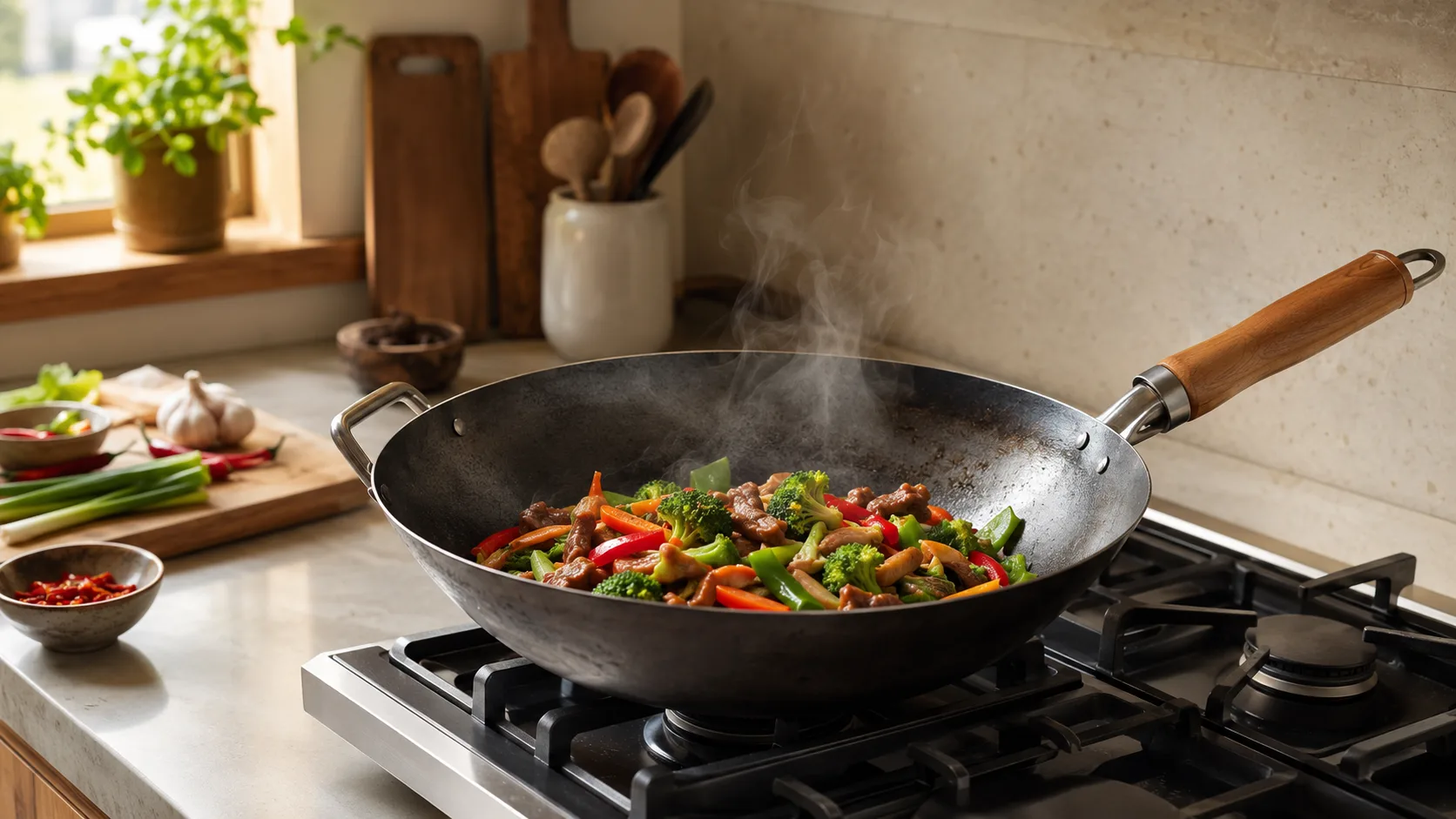
A good wok is not simply a large frying pan. Its curved sides create different heat zones, make it easier to move ingredients quickly, and let you stir-fry, steam, braise, deep-fry, and smoke food in one vessel. But the wok that performs beautifully over a powerful Chinese restaurant burner may be frustrating—or even unstable—on an electric or induction cooktop.
This guide focuses first on woks with a verifiable connection to China—not merely any pan shaped like a wok. Our strongest China-connected recommendation is the Craft Wok 14-inch flat-bottom hand-hammered wok, made by craftspeople in Guangzhou and adapted for common Western stovetops. The Yosukata 13.5-inch flat-bottom wok, which the brand says is made in China, is the easier all-round choice for beginners because it is pre-seasoned and widely cooktop-compatible. Made In appears only as a clearly labeled Western-made alternative, while Joyce Chen is included for its Chinese-American culinary legacy rather than presented as a mainland Chinese brand.
Quick answer: the best China-connected woks for Western kitchens
- Best China-connected pick: Craft Wok 14-inch flat-bottom hand-hammered wok — made in Guangzhou
- Best beginner-friendly China-made pick: Yosukata 13.5-inch flat-bottom carbon-steel wok — brand-stated China manufacture
- Best Chinese-American legacy option: Joyce Chen 14-inch flat-bottom carbon-steel wok — verify the current model’s origin
- Western-made alternative: Made In 13-inch seasoned carbon-steel wok — made in Sweden, not a Chinese product
Short rule: Choose a flat bottom for electric, ceramic, or induction. Choose round bottom only when your gas setup safely supports a wok ring or dedicated wok burner.
Comparison table: origin and China connection
| Wok | Brand / verified origin | China connection | Best for | Main trade-off |
|---|---|---|---|---|
| Craft Wok flat bottom 14 in; 1.8 mm carbon steel |
International-facing brand; made in Guangzhou, China | Direct: Chinese manufacture and hand-hammered production | Buyers prioritizing verifiable Chinese production and heat retention | About 4.6 lb; harder to toss one-handed |
| Yosukata flat bottom 13.5 in; pre-seasoned carbon steel |
Brand states its woks are made in China | Direct: China-made, designed for international buyers | Beginners and mixed cooktops | Origin is stronger than brand-locality; still needs seasoning care |
| Joyce Chen flat bottom 14 in; carbon steel |
Chinese-American culinary brand; origin can vary by model | Cultural: Chinese cooking adapted for Western homes | Value-focused first-time buyers | Check the exact listing for current country of manufacture |
| Made In seasoned wok 13 in; 1.5 mm carbon steel |
US brand; current wok made in Sweden | Comparison only: not a Chinese product | Buyers wanting a lighter premium Western alternative | Higher price and outside this guide’s core China-made focus |
Manufacturing locations and specifications can change. Confirm the exact model, country of origin, and cooktop compatibility before ordering.
What “Chinese wok” means in this guide
“Chinese wok” can describe a cooking-vessel style, a Chinese-owned brand, a product made in China, or a product rooted in Chinese culinary culture. Those are not interchangeable. To keep this guide transparent, we label each recommendation by brand identity, verified manufacturing location, and type of China connection.
A “made in China” label alone does not prove quality, and a non-Chinese brand can still commission an excellent Chinese-made wok. We therefore evaluate both provenance and practical construction. Craft Wok has the clearest mainland-China production story in this comparison; Yosukata provides a practical China-made option for international kitchens; Joyce Chen represents Chinese-American culinary adaptation; and Made In is included only as a non-Chinese benchmark.
How we selected these woks
This is a researched buying guide, not a lab test. We compared manufacturer specifications, stated manufacturing origin, China connection, shape, material thickness, handle design, cooktop compatibility, seasoning requirements, and independent test findings. We gave extra weight to the problems international buyers most often encounter: a round wok that will not sit safely on a flat stove, an oversized pan that overwhelms a weak burner, or a coated “wok” that cannot tolerate true stir-fry heat.
We did not rank products by star count alone, and we did not treat “made in China” as an automatic sign of either quality or poor quality. Construction, steel thickness, geometry, quality control, and suitability for your stove matter far more than a country label.
1. Yosukata 13.5-inch flat-bottom carbon-steel wok — best beginner-friendly China-made pick
Yosukata states that its woks are manufactured in China. Its flat-bottom model is the most approachable China-made starting point for a typical North American, British, Australian, or European kitchen. The 13.5-inch diameter provides useful cooking room without becoming unmanageable, while the flat base is designed for gas, electric, ceramic, and induction surfaces. The brand lists pre-seasoned carbon steel and a wooden handle, so the pan arrives with a useful head start rather than completely bare metal.
“Pre-seasoned” does not mean maintenance-free. Carbon steel becomes easier to cook with as repeated thin layers of oil polymerize on the surface. You still need to heat it properly, avoid prolonged soaking, dry it immediately, and apply a very light film of oil after cleaning.
Why it stands out
- Practical flat-bottom geometry for common home stoves
- Responsive carbon steel rather than slow, very heavy cast iron
- Useful family-friendly size
- Pre-seasoning reduces—but does not eliminate—the setup process
What to consider
- It is heavier than the thinnest entry-level woks
- The wooden handle limits some oven-seasoning methods
- Acidic sauces can temporarily weaken a young seasoning layer
Best for: Buyers who want one versatile first wok and are willing to learn basic carbon-steel care.
Check the current Yosukata model and specifications.
2. Made In seasoned carbon-steel wok — Western-made comparison alternative
Made In is a US cookware brand, and its current seasoned carbon-steel wok is listed as made in Sweden. It is therefore not a Chinese product and appears here only as a Western-made comparison alternative. The wok uses 1.5 mm construction and a flat base intended for gas, electric, and induction cooking. That thinner build makes it easier to maneuver than a heavy 1.8 mm commercial-style pan, while carbon steel still heats and cools more responsively than cast iron.
The premium here is not a magic nonstick surface. You are paying for refinement, manageable weight, and a design that transitions comfortably between Western cookware habits and wok cooking. It is especially attractive if you already know that a very heavy wok will stay in the cupboard.
Why it stands out
- Lighter 1.5 mm construction
- Flat base for mainstream cooktops
- Seasoned surface provides a faster start
- High-heat capability suited to searing and stir-frying
What to consider
- Costs substantially more than many basic carbon-steel woks
- Thinner steel can lose heat when a large cold batch is added
- Still requires carbon-steel cleaning and seasoning habits
Best for: Frequent cooks who value maneuverability and polished construction more than the lowest price.
View the current Made In wok specifications.
3. Craft Wok 14-inch flat-bottom hand-hammered wok — best China-connected pick
Craft Wok says this flat-bottom model is hand-hammered by craftspeople in Guangzhou, giving it the clearest verifiable mainland-China production connection in this comparison. It uses 15-gauge (about 1.8 mm) carbon steel and weighs roughly 4.6 pounds according to the current product listing. That added mass helps it retain heat better when food hits the pan, while the 14-inch bowl provides plenty of room for moving ingredients up and away from the hottest center.
The trade-off is obvious: it is not a pan most people will casually flip with one wrist. The helper handle matters. This is a better choice for cooks who stir and scoop with a wok spatula than for anyone imagining constant restaurant-style tossing on a domestic burner.
Why it stands out
- Thicker commercial-style carbon steel
- Hand-hammered appearance and sturdy construction
- Large 14-inch working area
- Helper handle improves two-handed control
What to consider
- Heavy compared with beginner models
- Requires initial seasoning unless the exact listing says otherwise
- A 14-inch wok can crowd a compact cooktop
Best for: Cooks who prioritize stability and heat retention and do not mind extra weight.
Check Craft Wok’s current flat-bottom model.
4. Joyce Chen 14-inch flat-bottom carbon-steel wok — best Chinese-American legacy option
The Joyce Chen name carries genuine Chinese-American culinary history, but buyers should not confuse cultural heritage with a guarantee that every current model is made in mainland China. Manufacturing origin can vary, so check the exact listing. Its flat-bottom carbon-steel wok remains a long-established gateway into wok cooking. Its 14-inch bowl offers generous capacity, and wooden main and helper handles are comfortable for everyday stovetop use. Independent cooking publications have repeatedly highlighted its value and approachable balance.
Its thinner steel is both the advantage and limitation. It heats quickly and is easier to handle, but a large quantity of cold meat or vegetables can pull the temperature down. The solution is not necessarily a more expensive wok: cook in smaller batches, preheat properly, and avoid crowding.
Why it stands out
- Accessible entry price
- Comfortable wooden handles
- Generous 14-inch size
- Quick response to burner adjustments
What to consider
- Lower heat retention than thicker models
- Usually needs careful first seasoning
- Helper handles can become hot during extended cooking
Best for: First-time wok owners who want to learn the technique before investing more.
Review current Joyce Chen wok options.
Flat-bottom vs round-bottom wok
Choose a flat bottom if you have:
- Induction
- Electric coil or smooth-top electric
- Ceramic glass
- A standard gas range without a secure wok ring
A flat base creates stable contact with the cooking surface and is the safest general recommendation for Western kitchens. On induction, verify that the particular wok is magnetic and that its flat contact area is large enough for your cooktop to detect.
Choose a round bottom only if you have:
- A dedicated wok burner
- A gas range with a manufacturer-approved, stable wok ring
- Enough flame coverage to heat the curved lower walls
Round-bottom woks offer smooth utensil movement and classic heat zoning, but they can wobble dangerously on a flat surface. Never improvise an unstable support.
Carbon steel, cast iron, stainless steel, or nonstick?
Carbon steel: best for most people
Carbon steel combines quick response, high-heat tolerance, and manageable weight. It develops a natural patina rather than relying on a synthetic coating. The cost is maintenance: it can rust, it dislikes soaking, and its seasoning evolves over time.
Cast iron: excellent retention, difficult weight
Cast iron stays hot after cold food is added but responds slowly when you lower the burner. Large cast-iron woks are also cumbersome. It can work well for stationary cooking, but it is not our first choice for fast tossing.
Stainless steel: durable but less forgiving
Stainless steel tolerates acidic foods and requires no seasoning, but lean proteins can stick unless heat and oil are controlled carefully. Multi-layer stainless models are often heavier and more expensive.
PTFE-style nonstick: convenient but not for extreme heat
Coated woks are easy to clean and useful for gentle cooking, but high-temperature empty preheating and metal wok spatulas can shorten coating life. Follow the manufacturer’s temperature and utensil guidance.
What size wok should you buy?
- 12 inches: one or two people; easier to store; batches must stay small
- 13 to 14 inches: the best all-purpose range for most households
- 16 inches or larger: generally too large for an ordinary residential burner unless you cook outdoors
A bigger wok does not automatically create better wok hei. If the burner cannot recover after you add food, the ingredients steam rather than sear. For most homes, a 13- or 14-inch carbon-steel wok plus disciplined batch size is the practical sweet spot.
How to season and maintain a carbon-steel wok
- Read the maker’s instructions. Some pans arrive with protective factory oil that must be scrubbed away; others are pre-seasoned.
- Dry with heat. After washing, place the wok over low heat until every trace of moisture disappears.
- Use a very thin oil film. Wipe a high-smoke-point oil across the warm metal, then wipe again as if trying to remove it.
- Cook fatty, non-acidic foods early. Stir-fries with oil help build the surface. Long tomato or vinegar braises can wait until the patina is stronger.
- Do not panic over cosmetic changes. Bronze, blue, brown, and black patches are normal as seasoning develops.
- Treat rust promptly. Scrub the affected spot, dry thoroughly, and re-season.
Modern dish soap is not automatically fatal to seasoning, but dishwashers and long soaking are poor choices. The practical goal is a clean, dry pan with a microscopically thin protective oil layer—not a sticky, greasy surface.
Common buying mistakes
- Buying a round bottom for induction: it lacks stable contact and may not be detected.
- Choosing an oversized wok for a weak burner: the food steams while the outer walls remain underheated.
- Confusing pre-seasoned with maintenance-free: carbon steel always needs drying and continued seasoning.
- Using a coated wok like restaurant carbon steel: extreme empty preheating can damage nonstick coatings.
- Ignoring handle materials: wood stays comfortable on the stove but limits oven use; metal tolerates ovens but gets hot.
- Chasing authenticity over fit: the most “traditional” shape is not the best purchase if it is unsafe on your stove.
Our final recommendation
For the broadest range of Western home kitchens, buy a 13- to 14-inch flat-bottom carbon-steel wok. If a verifiable mainland-China production story matters most, choose the Craft Wok made in Guangzhou. If you want a more beginner-friendly China-made option, the Yosukata 13.5-inch flat-bottom model better balances cooktop compatibility and pre-seasoning. Joyce Chen is the value-oriented Chinese-American legacy choice, subject to checking the exact model’s origin. Made In is a capable premium alternative, but it is made in Sweden and should not be mistaken for a Chinese product.
Before ordering, measure your burner area, confirm induction compatibility if relevant, and decide honestly whether you will maintain carbon steel. The best wok is the one that matches your stove and your habits—not the one that looks most impressive online.
Frequently asked questions
Can I use a wok on an induction cooktop?
Yes, if it has a magnetic flat base and the manufacturer lists induction compatibility. Round-bottom woks are not suitable for a standard flat induction surface.
Is carbon steel naturally nonstick?
Not when brand new. A well-seasoned surface becomes increasingly low-stick with correct preheating, oil, and use, but it does not behave exactly like a synthetic nonstick coating.
Is a 14-inch wok too large?
For most four-person households it is practical, provided the burner is strong enough and the cooktop has adequate clearance. For one person or a small apartment kitchen, 12 to 13 inches may be easier.
Do I need a wok ring?
Not for a flat-bottom wok. A round-bottom wok requires a stable support designed for your gas range or a dedicated wok burner. Do not use a loose ring on a flat electric or induction surface.
Can I cook acidic food in carbon steel?
Yes, but long acidic cooking can strip a young seasoning layer and may create a metallic taste. Once the seasoning is established, brief acidic sauces are usually less troublesome.
Looking for more product research connected to China? Visit our Chinese Products & Buying Guides hub. If you are planning a trip rather than outfitting a kitchen, start with our China Travel Guide.